


INTA2026: AI moves from experiment to infrastructure in IP management
05 May 2026
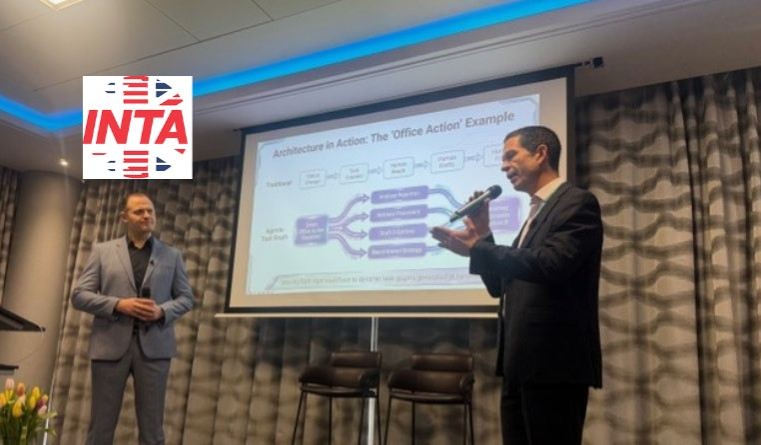
Artificial intelligence is rapidly shifting from a peripheral tool to a core layer of intellectual property management, according to speakers at a seminar on the sidelines of the International Trademark Association’s 148th Annual Meeting in London. What once focussed on experimental document review and search tools is now evolving into AI‑native platforms that reshape how IP portfolios are managed, monitored and monetized.
Speaking at the session, Toni Nijm, the Jersey-based chief product officer at Anaqua, and Florian Traub, a partner at Pinsent Masons in London, described a market undergoing structural change, driven as much by client demand as by technological capability. Their observations align closely with broader industry trends identified by IP offices and professional bodies worldwide, which increasingly frame AI as an operational necessity rather than a competitive advantage.
From docketing systems to AI-native IP platforms
Nijm traced the evolution of IP management software over several decades. “We started with simple docketing databases, moved to asset‑management platforms, then to AI‑enabled systems – and now we’re entering the era of AI‑native IP management systems,” he said. The difference, he explained, is fundamental: AI-enabled systems assist users, while AI-native systems rely on artificial intelligence to drive workflows end‑to‑end.
In practice, this means tasks such as deadline docketing, document classification, translation and even first‑draft responses to routine office actions can now be triggered automatically on ingestion of official correspondence. This mirrors findings from the World Intellectual Property Organization (WIPO), which has reported increasing use of AI by IP offices and rights‑holders to manage surging volumes of filings with fewer resources.
For law firms, AI adoption is no longer discretionary. Traub said large corporate clients increasingly expect their advisers to deploy technology that delivers cost certainty, transparency and real-time insight. “Clients absolutely expect AI to be used – securely and meaningfully – to automate day‑to‑day IP processes,” he told the audience.
That expectation is echoed in surveys by INTA and other professional bodies, which show that brand owners now prioritize data visibility and portfolio analytics over traditional static reporting. At Pinsent Masons, Traub said the response has been to integrate IP data, monitoring services and analytics into a single client‑accessible platform, available around the clock. “It becomes a single source of truth,” he said.
AI as risk reduction, not just efficiency
While much public attention on AI in law focusses on drafting and creativity, the London discussion emphasized operational risk reduction. Nijm noted that AI-driven automation reduces the likelihood of missed deadlines, inconsistent record‑keeping and manual error – persistent concerns highlighted in regulatory guidance from the European Union Intellectual Property Office (EUIPO) regarding portfolio compliance.
Demonstrations included automated translation of foreign-language office actions, extraction of relevant legal data, and a “catch me up” feature that provides AI-generated summaries of recent activity across entire portfolios. These tools are designed to support, not replace, professional judgment, shifting attorney time toward strategic advice and enforcement planning.
Despite accelerating technical capability, both speakers stressed that successful AI deployment depends on people. Pinsent Masons has invested heavily in training programmes, internal workshops and structured rollouts to ensure tools are embedded meaningfully into daily practice.
“You don’t get value just by switching something on,” Traub said. “You get it by changing how people work.” He added that the firm has seen unusually high adoption of general AI tools such as Microsoft Copilot compared with peers, a trend consistent with recent UK legal‑sector technology surveys.
AI has also forced difficult conversations around cost allocation. Traub cautioned against applying blanket AI surcharges to client bills, noting that resistance is widespread. “Clients don’t respond well to a percentage uplift for AI,” he said, explaining that his firm instead absorbs costs through retainers while articulating value through service outcomes.
This approach aligns with guidance from legal regulators and bar associations, which emphasise transparency, human oversight and data security as central to ethical AI use in legal services.
Looking ahead, Nijm predicted further fragmentation of AI capabilities into specialized agents, each optimized for tasks such as prosecution, monitoring, enforcement or invoicing. Multiple large language models can be deployed simultaneously, chosen for accuracy, speed or cost depending on context.
“The goal isn’t to replace IP professionals,” Nijm said. “It’s to automate everything that doesn’t need human judgment, so lawyers can focus on strategy and client‑critical decisions.”
As AI becomes embedded in both IP offices and private practice, the consensus emerging in London was clear: artificial intelligence is no longer an emerging technology in IP management – it is rapidly becoming the infrastructure on which modern IP practice is built.
- By Darren Barton in London