Please wait while the page is loading...

loader

AI and the law firm

25 January 2026

AI and the law firm

How is AI helping lawyers in their legal practice? Espie Angelica A. de Leon shares how law firms are adopting AI tools to improve efficiency, while balancing concerns over data privacy, ethics and regulations across different jurisdictions. 
 

There’s no escaping artificial intelligence. 

The technology continues to attract more and more users – from individuals, universities, government offices and companies across industries.  

These include the legal services industry. AI has certainly found its way into the legal profession where lawyers and attorneys, including those in the intellectual property practice, are already using AI tools or are considering using them.  

From June 30 to July 31, 2025, global transformative intelligence provider Clarivate surveyed over 400 IP and research and development (R&D) professionals from Europe, North and South America, Asia Pacific, the Middle East and North Africa. The participants included attorneys, in-house counsel and paralegals. Focus areas were patents and trademarks. The survey resulted in a report titled “The evolution of AI in IP.”  

Some of the key findings in the report are:  

  • AI solutions are already used to some extent by 85 percent of IP professionals worldwide, up from 57 percent in 2023. 

  • Attorneys are still cautious about AI. It’s the executives and R&D professionals who are most comfortable with the technology. 

  • Patentability analysis is among the top AI use cases, along with R&D and competitive intelligence. 

What AI tools are the lawyers using? How is AI helping them in their legal practice in general, and in IP as an area of focus in particular? What are the tradeoffs, if any?  

How AI is useful in legal practice 

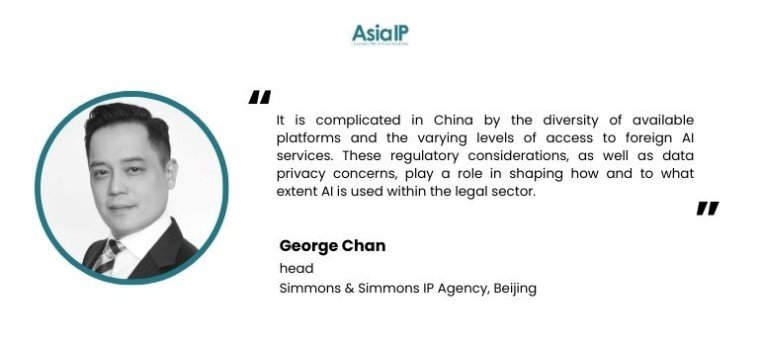
“Yes, our firm utilizes AI tools including Percy, our in-house legal AI assistant, and Microsoft Copilot to support various tasks and processes,” revealed George Chan, a partner at Simmons & Simmons and head of Simmons & Simmons IP Agency in Beijing. 

He related that their experience with AI has been very positive. The tools they use excel at automating routine tasks such as document review, legal research and translation, freeing up more time for lawyers to focus on more complex and strategic work instead. Aside from saving time, these AI solutions also translate to greater work efficiency. 

“In the context of IP practice, AI can quickly analyze large volumes of data, assist with prior art searches and streamline the drafting and translation of documents. This benefits both the firm and our clients by reducing turnaround times, improving accuracy and lowering costs,” said Chan. 

The adoption of AI platforms in China’s legal services industry is progressing, according to Chan. “But it is complicated in China by the diversity of available platforms and the varying levels of access to foreign AI services. These regulatory considerations, as well as data privacy concerns, play a role in shaping how and to what extent AI is used within the legal sector,” he said. 

“Yes, we utilize a tiered approach to AI adoption, ranging from essential, simple tools to more complex, specialized platforms for sophisticated tasks,” said Arjel P. de Guzman, a partner at de Guzman Mayuga in Manila. 

More specifically, they’re using AI software for writing and grammar correction, research, analytics and basic document drafting. “As an advantage, AI can be utilized to handle the ‘grunt work’ in the firm, all in significantly less time. This drastically reduces the time and labour cost associated with the early stages of a case or filing, leading to more competitive billing models,” said de Guzman.  

For IP work, he said AI helps immensely. IP maintenance is always time-driven and time-sensitive, and AI platforms help in monitoring sensitive due dates and timelines.  

“Patent prosecution can also be assisted drastically by AI tools. AI tools are superior at tasks requiring exhaustive comparison. They mitigate the risk of missing critical prior art or potential trademark conflicts across multiple jurisdictions, leading to stronger, more defensible IP filings. To some extent, AI can likewise assist in drafting claims,” de Guzman stated. However, he believes this area still needs more polishing. 

Some law firms are not as active in using AI solutions in their day-to-day operations. They’re being cautious due to data retention and confidentiality issues. 

As Chan mentioned, AI uptake in China’s legal profession is seeing some progress. However, data privacy concerns along with regulatory considerations will help dictate how and to what extent AI is used within the jurisdiction’s legal sector. 

One such law office that is less active in terms of AI adoption is LexOrbis in New Delhi. The firm undertook trials involving AI solutions for patent preparation or prosecution and patent search. LexOrbis conducted the trials on published cases – part of an effort to evaluate how AI tools can complement their practice. 

According to Manisha Singh, founder of LexOrbis, their experience during testing was positive, with some of the tools demonstrating the ability to improve efficiency by generating initial drafts and providing reference search results quickly. As such, turnaround time for certain tasks was reduced.  

Yet, the firm remains cautious. “For IP work, client trust is paramount, and some clients have expressed skepticism about AI platforms,” Singh revealed. “In fact, we have signed agreements with a few clients confirming that their data will not be processed through AI tools. While AI can enhance productivity, these concerns highlight the need for robust compliance and transparency from AI tech providers.” 

Nevertheless, Singh said LexOrbis believes AI does have potential; it’s just that adoption must be selective, rather than widespread. “For services involving highly confidential client data, such as patent drafting or patentability searches for new inventions, we are unlikely to use AI tools until we have absolute clarity on data security issues,” she disclosed. “However, for tasks like patent prosecution or invalidity searches where we need to work on publicly available office actions and patents, we see no harm in leveraging AI if it improves efficiency and accuracy.” 

According to her, the uptake of AI in India’s legal services industry has been gradual. A lot of the law offices are actually exploring AI solutions. However, concerns over confidentiality and compliance prevail, thus preventing widespread adoption within the legal profession.  

“Over time, as these issues are addressed and cost efficiencies become clearer, we expect AI usage to become more common across the profession,” Singh remarked. 

Dentons Kensington Swan in New Zealand is doing the same. The law firm is the launch client in New Zealand for Legora AI, a generative AI platform designed by lawyers, for lawyers. 

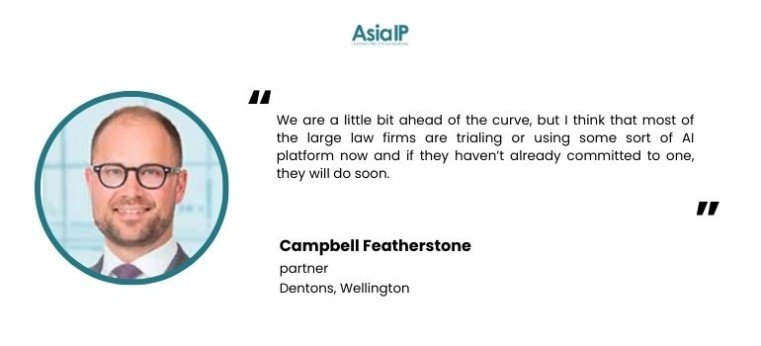
“We are still working out exactly what it means for us, but we are looking to use it to simplify time-consuming tasks and enhance everyday workflows,” revealed Campbell Featherstone, a partner at Dentons Kensington Swan in Wellington.  

“I think that all legal practices will benefit from the adoption of AI tools, provided that they go about that adoption in a sensible manner and with appropriate guardrails. The key is to understand what AI is good at, and what its limitations are, and then play to its strengths,” he added. 

Featherstone emphasized that AI won’t replace critical or strategic thinking, or commercial nous. Instead, AI solutions must be regarded as tools or platforms that augment what lawyers and attorneys do, allowing them to devote more time and energy to the critical or strategic thinking components of legal work. 

So how is AI adoption among law offices in New Zealand? 

“We are a little bit ahead of the curve, but I think that most of the large law firms are trialling or using some sort of AI platform now, and if they haven’t already committed to one,” said Featherstone, “they will do soon.”  

De Guzman himself admitted that while some AI-assisted software is a staple in their firm’s day-to-day operations, majority are still primarily on the evaluative stage. 

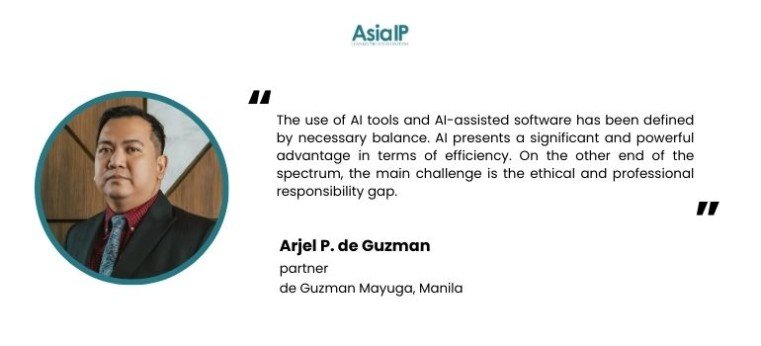
“Thus far, the use of AI tools and AI-assisted software has been defined by a necessary balance. AI presents a significant and powerful advantage in terms of efficiency. On the other end of the spectrum, the main challenge is the ethical and professional responsibility gap. AI output must always be treated as a draft or a research guide, not a final product. A lawyer is ethically and professionally accountable for any ‘hallucinations,’ mostly fabricated case law and prior arts, or even factual errors. Using AI demands higher technical literacy and robust internal protocols to maintain client confidentiality and data security, especially when using third-party, generalist large language models (LLMs),” de Guzman explained. 

As for AI uptake in the Philippine legal sector, he said it “leans toward the positive, but with measured traction.” 

There’s Digest AI and Anycase.AI, pioneering AI-powered platforms for legal research specifically trained on Philippine jurisprudence. According to de Guzman, the development and adoption of these AI solutions is a critical step that validates the technology for Filipino lawyers. 

“In substantial practice though, it is worth stressing that the IP Code has yet to clarify the authorship and ownership of AI-generated works, and the Data Privacy Act introduces complexity regarding client data fed into LLMs. This regulatory ambiguity still encourages a more prudent and cautious approach,” de Guzman noted. 

Will AI replace lawyers? 

Inevitably, the conversation surrounding AI will turn into talk of whether it will take away jobs, including that of the lawyer or attorney. 

“I think AI may well replace some jobs,” said Featherstone, “but I don’t think it will ever replace good lawyers.” He explained that good lawyers need to have a great understanding of the human dynamics and relationships that drive transactions, disputes and commerce generally. “The AI that I’m aware of can’t do that yet,” he pointed out, “and I’m not sure it will ever be able to.” 

“In our view, AI will function more like a calculator that eases calculations for humans, i.e., an aid that simplifies certain processes rather than replacing human expertise. Legal work, especially in IP, requires nuanced judgment, strategic thinking and client interaction, which cannot be replicated by AI tools,” said Singh. 

Chan and de Guzman agree.  

Chan thinks AI could be capable of handling increasingly sophisticated tasks as the technology advances, aside from the mundane, repetitive desk chores it has started to automate and replace. “But the role of lawyers in providing strategic advice and advocacy, as well as client-facing services, will remain difficult to replace with AI,” he claimed. Thus, he believes more complex and judgment-based tasks will continue needing human expertise, at least for the foreseeable future.  

“My take on this is that AI will drive transformation, not replacement,” de Guzman stated. For him, the function of AI remains augmentative. 

“In all, upskilling will be the more pressing concern,” he added. “The legal industry will have high demand for AI-enabled supervisors, data analysts and legal technologists who can manage the tools, interpret the data and provide strategic insight. The future of law is a hybrid practice where human judgment steers the efficient machine.” 

Has your law office begun adopting AI tools or platforms? If so, to what extent? Or maybe, AI is still largely in its trial stage at your organization, as is the case with some law firms.  

“There’s nothing wrong with that,” Featherstone noted, “but my advice to practitioners who haven’t yet engaged with the question of what AI means to their practice is that they can’t ignore the fact that AI is going to make a difference.” 


Law firms