Please wait while the page is loading...

loader

The controversial gene patent

31 October 2025

The controversial gene patent

Whether genes can be patented remains a global debate. Espie Angelica A. de Leon unpacks key cases, international rules and expert views on balancing innovation, accessibility and public health in gene-related inventions. 


The United States used to allow the patenting of genes, including human genes. The holder of a gene patent – whether an individual, organization or business that first identified the gene – had the right to decide how the gene or the specific gene sequence may be used, studied and commercially exploited for about 20 years. This included the use of the gene in any research activity or genetic testing. At one point, more than 4,000 human genes were patented in the U.S. 

Then came 2013 and the Association for Molecular Pathology v. Myriad Genetics, Inc. case. Court records indicate that Myriad is the first company to discover the exact location and sequence of two human genes, BRCA1 and BRCA2. The discovery enabled the company to develop medical tests to determine if there are BRCA1 and BRCA2 gene mutations. The existence of gene mutations means the individual has a greater cancer risk, especially breast, ovarian and prostate cancer. Following its discovery, Myriad acquired patents for gene isolation and the creation of cDNA, a synthetically created DNA also known as complementary DNA. With the patents, the company had exclusive right to create synthetic BRCA cDNA. The Association for Molecular Pathology and a number of medical groups and patients challenged the validity of the patents. 

The U.S. Supreme Court ruled that genes or DNA segments are not eligible for patents, being naturally occurring products of nature. Thus, all existing gene patents were nullified. What did not stop, however, was the granting of patents for manipulated DNA. 

“Whether genes can be patented is a very controversial issue,” said Xia Zheng, founder of AFD China in Beijing. “On the one hand, allowing gene patents can stimulate pharmaceutical research and development (R&D), which is generally high-risk and high-investment, and requires patent protection to recover costs. The patent system can also promote technological disclosure, avoid duplication of research, attract investment and promote industrialization.” 

Scientific, legal, ethical aspects  

What makes the subject controversial is the science behind the patenting of gene or DNA sequences, the laws and policies governing it and its ethical implications. 

“I don’t believe human genes must be patented,” said Zheng.  

According to Zheng, the question of whether to patent human genes is a legal, ethical and policy choice, not a scientific necessity. “Primarily, genes are products of nature – the sequencing of genes is a discovery, not an invention,” she remarked. “While it is possible to patent some discoveries from nature, such as an isolated active compound from a plant, or an isolated microorganism from soil, I don’t believe human genes should be patentable. If patentable, human gene patents can create limited access to genetic testing and research, and subsequently suppress innovation and the use rather than encourage it.” 

Zheng is seconded by Xie Lifei, a patent attorney at CCPIT Patent & Trademark Law Office in Beijing. “We consider it inappropriate to classify the human gene per se as patent-eligible subject matter,” said Xie. 

China’s Patent Examination Guidelines stipulate that the discovery of a gene or DNA fragment in its natural form is exactly that – a mere discovery rather than an invention. Such naturally occurring materials or substances as genes or DNA fragments fall under the definition of “scientific discovery” in accordance with Article 25, Paragraph 1, Item (1) of the Patent Law. Hence, any gene or DNA fragment in its natural form is not eligible for patent protection.  

However, a gene or DNA fragment may acquire patent protection under these conditions: 1) It is isolated or extracted from nature for the first time; 2) Its base sequence is unknown in the prior art and can be definitely characterized; and 3) It can be exploited industrially. According to Zheng, this is the most realistic approach and will allow the technology to be used as quickly as possible. 

In view of this, Xie said their team has made a creative adaptation in practice. “Whereas a transgenic animal, for example, a transgenic mouse carrying a modified human gene, is excluded from patentability in China, we have successfully reframed the claim as ‘a genome of an animal comprising a modified human gene,’ which is now accepted under the current examination practice,” she related. 

The methods of preparing the genes, uses of the genes, vectors or cells containing the genes are among other subject matter that may qualify for patent protection. 

Likewise, in Hong Kong, the discovery of a naturally occurring DNA sequence of a gene on its own is generally not eligible for patent protection. What may be patentable are the very process of extraction and isolation of the gene, as well as the material obtained from this process. 

Practical applications derived from the identified gene sequence could also be patentable subject matter, “provided that the invention is not directed to a method for the treatment of a human or animal body by surgery or therapy, or a diagnostic method practised on the human or animal body, since such methods are not considered to be susceptible to industrial application. However, substances or compositions for use in the above therapeutic or diagnostic methods which are susceptible to industrial application may be considered patentable subject matter,” said Victor Tse, counsel at Bird & Bird in Hong Kong. 

In addition, inventions relating to biological processes for producing plants or animals, except microbiological processes or its products, are unlikely to be patentable subject matter.  

The same applies to inventions that may be harmful to public order or are against morality. Such inventions include the following: processes for modifying the germ line genetic identity of human beings or a human being thus modified, processes of modifying the genetic identity of animals which may cause these animals to suffer without any substantial medical benefit to human beings or animals, the use of human embryos for industrial or commercial purposes, inventions relating to cloning. 

“Many countries in Asia do not allow patenting of naturally occurring material. This does not only apply to human genes but also to any other naturally occurring substances such as plant extracts, small molecules, etc.,” said Maik Brinkmann, life science practice group leader at Spruson & Ferguson in Singapore. “What can be patented is the use of genetic information in commercial applications. However, such a protection would not claim the human gene as such but only a particular application which forms the core of the invention.” 

In Australia, patent law generally does not cover gene sequences. D’Arcy v. Myriad Genetics Inc & Anor held that for claims where the substance of the invention was genetic information and that substance had not been ‘made,’ the subject matter is not patentable. “In practice, this means that claims to isolated genetic material in the form present in nature is not patentable. Similarly, cDNA is not patentable because the substance of the invention is still genetic information and that information is not made. In contrast, double-stranded interfering RNA, codon optimized genes and antisense oligonucleotides have been found patentable following the Myriad criteria. Methods of using genetic information such as diagnosis are not restricted by the Myriad decision and are patentable subject matter,” explained David Nowak, a director at Henry Hughes Intellectual Property in Wellington and patent attorney in Australia and New Zealand. 

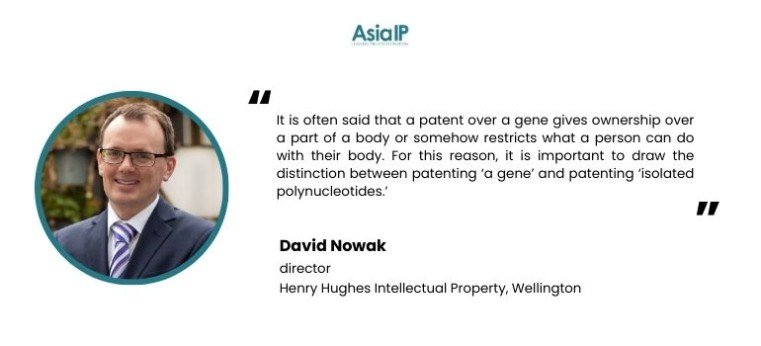
Nowak believes isolated naturally occurring polynucleotides, at least, should get patent protection as long as they meet the requirements of novelty, inventive step and utility. “Some of the concerns around gene patenting arise from misunderstandings,” he noted. “For example, it is often said that a patent over a gene gives ownership over a part of a body or somehow restricts what a person can do with their body. For this reason, it is important to draw the distinction between patenting ‘a gene’ and patenting ‘isolated polynucleotides.’ 

“An isolated nucleic acid molecule is a chemical compound, like a small drug molecule or protein,” Nowak continued. “Efforts to distinguish between polynucleotides and other compounds tend to create other difficulties. The U.S. Supreme Court’s focus on gene products being a product of nature spilled over to any naturally occurring compounds. Similarly in Australia where the High Court focussed on the information content of DNA, there has been difficulty around where the line lies.” 

He added that the requirements of novelty, inventive step and utility, if applied properly, can address issues with overly broad gene patents. This is especially so with currently available gene sequence information. 

According to Nowak, the ability to patent isolated genetic material encourages investment into gene technologies, thus opening the doors for more R&D initiatives in the field whose importance is presently growing.  

Meanwhile, the Intellectual Property Office of New Zealand allows claims to isolated genetic material. 

Challenges associated with patenting gene sequences 

According to Zheng, the basic controversy is that genes are something that exist in nature. The question arises: “Should isolating or identifying them be considered an ‘invention’ rather than a ‘discovery’?” This, seemingly, is the core of the controversy behind gene patenting. 

Zheng considered this question by citing the active compounds isolated from herbal medicines as an example. “These compounds exist in nature. They are generally patentable especially in jurisdictions such as China and Europe. However, their patentability with the U.S. Patent and Trademark Office should be evaluated more carefully,” she said.  

Explaining this statement, she noted that the U.S. has a much stricter rule compared to other jurisdictions. This rule states that isolating a substance found in nature is not enough to get a patent. In this case it may still be viewed as a product of nature. “In contrast, China and Europe are often more flexible. If you’re the first to isolate a natural substance and can show its structure and use, it’s more likely to be considered a patentable invention there. So, while the same compound might be considered a patentable invention in China or Europe, it requires a more careful and strategic application to meet the stricter U.S. threshold,” Zheng pointed out. 

Several jurisdictions including the U.S. used to allow patents on isolated and purified gene sequences. The reasons for this were twofold: 1) Such substances are not in their natural state; and 2) They possessed practical utility. “However, as gene sequencing technology has become routine,” Zheng noted, “this ‘isolation-is-invention’ view has come under intense scrutiny.” 

Zheng also delved into the legal and ethical aspect of the issue. Genes are fundamental building blocks of life, she said, and so resorting to gene patenting may be perceived as privatizing and commodifying life’s building blocks. “Many believe that the human genome is a common heritage that should not be monopolized by any one company or individual. If the position that isolated gene sequences with specific industrial applications can be patented, it will hinder scientific research and innovation and affect patient rights and medical accessibility,” she stated. 

The very requirement for an invention to be novel, inventive and industrially applicable in order to have patent protection also presents a challenge. This is because industrial applications of inventions relating to gene sequences are often technically complex and not self-evident. “So it is important to ensure that the patent specification is sufficiently detailed to support the claimed embodiments and adequately describes the beneficial technical effect achieved by the claimed invention, for example, with reference to supporting experimental data, gene sequence listings etc.,” Tse advised. 

Xie shared that, in China, the examination of the support by the description regarding gene-related claims is particularly stringent. “For example, gene or gene fragment claims defined by identity language such as ‘a gene having at least 80 percent identity to SEQ ID NO: 1’ are often rejected for lack of sufficient support,” she related. 

With the explosive growth in biotechnology research, another problem emerges. Such growth has led to the creation of a large pool of competing patents and prior art. “This makes it more challenging to obtain broad patent protection in this area, and also increases the complexity for companies to carry out freedom-to-operate analysis to understand the potential commercial risks of operating in this area,” Tse said. 

Jurisdictional differences in subject matter patentability offer a major challenge. Nowak explained: “In Europe and New Zealand, it might be possible to get a claim for an isolated polynucleotide with a sequence of a naturally occurring gene. In the U.S., this would not be possible, but a cDNA with this same information is likely patentable. It may also not be possible to get a patent for a diagnostic method using that gene in the U.S. In Australia, it would also not be possible to get a patent for the isolated polynucleotide, but unlike the U.S., it would also not be possible to obtain a patent for the cDNA. However, it would be possible to patent the diagnostic methods.” These differences, said Nowak, make it difficult to develop a global patent strategy which would protect a gene invention. 

Let’s get into the matter of inventions that are against public order, morality or laws. “Patentable subject matter objections based on [being] contrary to public order, morality or laws can change with the time and can be difficult to predict,” said Tse. 

Additionally, such patents may harm patients' rights and medical accessibility. There is also the risk of pharmaceutical companies monopolizing the pricing and raising medical costs. Patenting genes may also curtail subsequent research activities and efforts at innovation. 

“We believe that a middle path should be taken, balancing innovation incentives and public health,” remarked Zheng.  She suggested the following: 

  • Allow limited patent scope. Instead of protecting the gene itself, such limited scope will only protect specific applications such as a detection method or drug target. 

  • Compulsory licensing. “In times of public health crises or when high prices affect access, the government can compel third parties to use patents,” said Zheng. 

  • Patent pools and sharing platforms. “Encourage companies or research institutions to pool gene-related patents, lowering licensing barriers and promoting collaboration,” explained Zheng. 

What will the future look like for the scientific, business and IP communities as far as genes and patents are concerned? We can only guess. The controversy continues. It will serve these sectors well to know the facts and be updated to help them make informed, science-based decisions. 


Law firms