Please wait while the page is loading...

loader

AI’s starring role in the movies: Copyright challenges

25 August 2025

AI’s starring role in the movies: Copyright challenges

As artificial intelligence drives faster and more creative productions, it also sparks complex debates over copyright and ownership. Espie Angelica A. de Leon explores varied legal responses and emphasizes why responsible use is essential for protecting both artistry and innovation. 

There are film festivals, and then there are AI film festivals such as Runway’s AI Film Festival and the Busan International AI Film Festival. Indeed, filmmakers are bringing their art to new heights by tapping the power of AI, particularly generative AI (GenAI), for certain components of filmmaking.  

People behind television shows, videos and digital media are doing the same thing – in pre-production, production and post-production. Certainly, AI is now at the forefront of production work, assuming a starring role in the movies. 

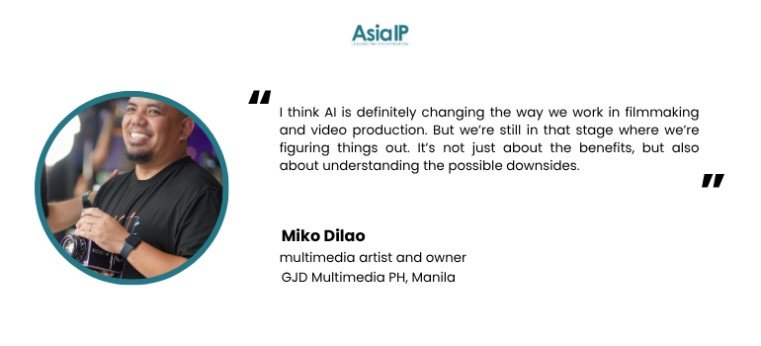
“I’ve seen how AI has changed our own workflow, especially in storyboarding,” said Miko Dilao, multimedia artist and owner of the studio GJD Multimedia PH in Manila. “We used to build storyboards manually, frame by frame, which took a lot of time and effort. Now, we can generate visuals based on prompts, which has sped things up a lot.” 

Kun Quan Huang, director at GrX SEA Growth Enterprises in Singapore, agreed. “As we try to express ideas to colleagues, GenAI enables a lot more draft designs to flow, and we can reach better mutual understanding. GenAI also works great for sci-fi designs. Many characters and worlds can be quickly generated for internal communication. Getting you to see what I see – that is crucial to the collaborative process of filmmaking,” he explained. 

He said he has also used AI for research. “Web-crawling to amalgamate enormous amounts of information is something AI does well,” Huang pointed out.  

Some production houses are also relying on AI for editing, sound cleanup, voiceovers, scriptwriting, subtitling, costume design, transcribing, drafting contracts and other paperwork, as well as translation of marketing paraphernalia.  

"I think AI is definitely changing the way we work in filmmaking and video production. But we’re still in that stage where we’re figuring things out. It’s not just about the benefits,” said Dilao, “but also about understanding the possible downsides and being responsible with how we use it."

These possible downsides include issues related to copyright. 
 

Copyright: Challenges and risks 

Foremost of these issues is the burning question in the AI and copyright debate: Can AI-generated works be copyrighted?  

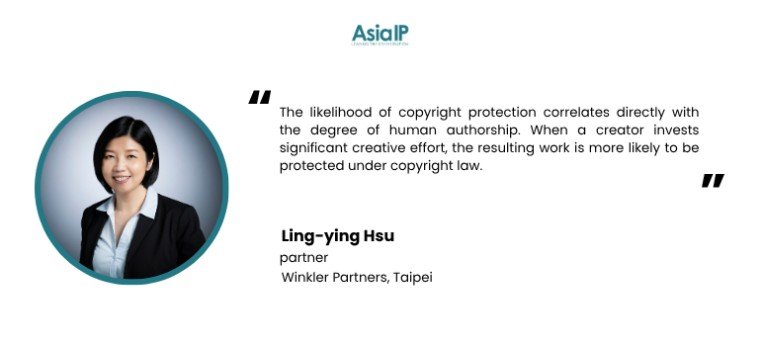
“The answer hinges on a critical distinction: works independently created by AI versus works created with the assistance of AI,” said Ling-ying Hsu, a partner at Winkler Partners in Taipei. 

Works independently generated by AI are those created with minimal intervention by a human being. Often, these are created using a simple prompt. 

Works created with AI assistance involve more human intervention with a significant amount of creativity.  

"The likelihood of copyright protection correlates directly with the degree of human authorship. When a creator invests significant creative effort — for instance, by providing highly specific prompts, curating input materials and extensively revising the AI's output to align with their artistic vision — the resulting work is more likely to be protected under copyright law,” Hsu explained.

“Therefore, film studios utilizing AI must ensure that the technology serves as a tool to augment, not replace, human creative contribution. If human authorship is deemed insufficient, the resulting film, despite the labour involved, may not qualify for copyright protection,” she added.  

Another fundamental question is: Who owns the copyright? 

In most copyright regimes, laws state that the owner of the copyright must be a natural person. “This human authorship requirement is a major sticking point. If an AI autonomously creates a script, a piece of music or visual effects, can it be considered an author? If not, who is? The AI developer? The user who prompted the AI? The production company funding the AI’s use? This ambiguity creates significant uncertainty regarding ownership rights,” said Arjel P. de Guzman, a partner at de Guzman Mayuga in Manila. 

There is also the risk of infringing someone else’s copyright. 

Generative AI models are trained on vast datasets that include films, screenplays, music, images and artwork. “A key risk is whether the act of training an AI on copyrighted content without permission constitutes copyright infringement. Furthermore, if the AI output too closely resembles or is substantially similar to existing copyrighted works, it could lead to infringement claims against the creators using the AI or even the AI developers themselves. This is especially pertinent for things like deepfakes or AI-generated character likenesses,” said de Guzman. 

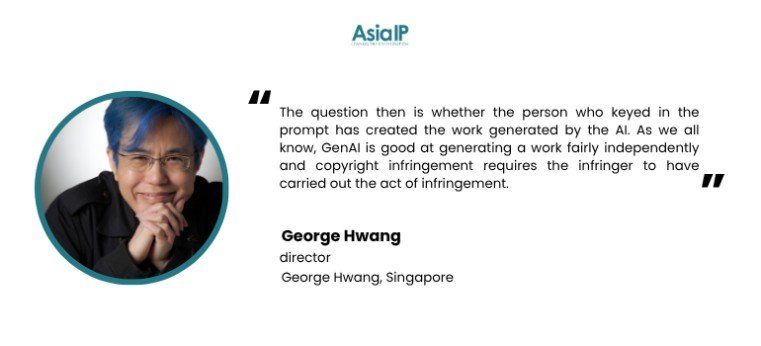
“The question then is whether the person who keyed in the prompt has created the work generated by the AI,” said George Hwang, director of George Hwang in Singapore. “As we all know, GenAI is good at generating work fairly independently, and copyright infringement requires the infringer to have carried out the act of infringement.” According to Hwang, most of the litigation so far relates to this stage or has the GenAI companies as defendants. 

The idea-expression dichotomy presents another challenge. Copyright laws protect the expression of an idea, not the idea itself. Such expression may come in the form of text, music, visuals and others.  

“The prompt fed to the GenAI could just be the idea and not the expression. Text-to-image models are likely to create works which fit into this distinction,” Hwang explained. 


AI and legislation 

“It is essential to properly manage these risks through multi-dimensional collaborative governance to promote the healthy, sustainable and innovative development of the AI-powered film industry,” said Peng Zhang, senior counsel at Zhong Lun Law Firm in Beijing. 

Are legal frameworks for IP in the region robust enough to address the use of AI in film, TV, video and digital media, considering the rising number of adopters? According to de Guzman, the Intellectual Property Code of the Philippines, like IP laws in many other jurisdictions, has significant limitations in fully addressing the complex IP challenges posed by AI in film production. One major hurdle is the IP Code’s very definition of “author” as a “natural person.” This means purely AI-generated works are not eligible for copyright protection 

“However, notwithstanding such challenges, it is worth noting that attempts have been made to pass AI-focused legislation. There are several AI-related bills previously introduced in the Philippine Congress that aim to establish regulatory frameworks for AI. While these bills are still in development and may have varying definitions and scopes, they demonstrate a legislative awareness of AI’s growing impact and the need for new laws,” noted de Guzman, who provides advisory services to production companies and individual creatives who are exploring or are already incorporating AI into their workflows. 

“Singapore has not really addressed the liabilities of users of GenAI which has created work independently, from both primary and secondary infringement perspectives,” said Hwang. “For primary infringement, the infringer is the one who has committed the act of copying. For secondary infringement, there is a requirement that the infringer knows that the article dealt with commercially or distributed is an infringing article. The knowledge need not be actual. It can be constructive. The phrase used in our Copyright Act 2021 is ‘ought reasonably to know.’ To what degree should this be?” Hwang asked. 

Hwang added that the Copyright Act 2021 has changed the phrase “fair dealing” to “fair use.” “Since ‘fair use’ is found in the U.S. Copyright Act, I would like to know how the Singapore court will construe this aspect of ‘permitted use,’” he said. 

Under Taiwan’s IP law, AI-assisted works may receive copyright protection as long as significant and substantial human creative input is involved. This means that AI was merely used as a tool to create the work. In contrast, works that are independently generated by AI with no human intervention cannot have copyright protection. 

However, the Taiwan Intellectual Property Office has yet to provide clear criteria on the level of human contribution required for a creative work to receive copyright protection. Not a single court ruling within the jurisdiction has specifically addressed this issue. 

“As a result, it remains uncertain how film studios can confidently incorporate AI into their production process while ensuring their works are protected by copyright law,” said Hsu. Say, a film studio uses AI to create an initial draft of a scene for a movie. Later, this draft is modified, this time with human involvement. According to Hsu, two questions could arise: Would the resulting work be protected by copyright? How much human modification is needed before AI is considered merely a tool? 

“I believe China’s legal system is capable of addressing these challenges, having established a considerable regulatory framework,” said Zhang. “At the foundational level, the Civil Code and Copyright Law codify the essential provisions for rights protection. The 2022 Provisions on the Administration of Algorithmic Synthesis in Internet Information Services and the 2023 Interim Measures for the Management of Generative Artificial Intelligence Services have introduced targeted requirements across various dimensions. These include mandating the use of legally sourced data and base models, prohibiting infringement of IP rights lawfully held by others, ensuring training data authenticity and reliability, among others,” he added.  

How to avoid IP issues 

What should production people in film, TV, video and digital media do to make sure their AI-assisted work outputs do not infringe copyright and are eligible for protection? 

“We’re very mindful of that,” said Dilao. “For storyboarding, the AI-generated images we use are just for internal planning. They’re never published or used in the final output. It’s really just a tool to help visualize ideas early on, so we don’t run into IP issues there.” 

When it comes to AI voiceovers, Dilao said, the company makes sure to use only legitimate, licensed platforms – usually subscription-based tools. “We know we’re staying on the right side of legal and ethical use. We’re careful with what we use and how we use it, especially since we also work with brands and clients who trust us to protect their reputation as well,” Dilao added. 

“Many of the tools we use have had [machine learning] tools over the years, like Adobe Premiere and iZotope, and we trust that they do use training data that are properly sourced. [With] newer AI tools, we try to stick with more reputable companies that will use training data responsibly,” said Yee-wei Chai, a film director, writer, producer and founder of Mocha Chai Laboratories, Southeast Asia’s first one-stop digital film studio located on Ubi Road, Singapore. 

Hsu’s suggestion is for studios to document and preserve evidence of their people’s creative contributions, representing human involvement, during the entire production process. Disney’s legal team is doing exactly that. According to The Wall Street Journal, the entertainment conglomerate’s lawyers are working to ensure copyright protection eligibility by reviewing the usage of AI across its projects. For Captain America, the team reportedly preserved more than 200GB of art direction revision records.  

“Yet not all studios have the legal or financial resources to undertake such extensive documentation,” noted Hsu. One possible solution, she says, is to go beyond traditional copyright and opt for a new legal right that protects AI works with little or no human creative intervention. One such right is the sui generis rights granted under a law introduced in Ukraine in January 2023. “These rights, while narrower in scope and excluding moral rights, offer content creators some degree of control over usage and unauthorized exploitation,” said Hsu. 

For Huang, legal advisors with knowledge of the obligations in this area will contribute to a healthy ecosystem where artists are fairly compensated and efficiency is enhanced by new tools. He explained: “AI platforms cannot generate something from nothing. They need the visual data to train their software. Has this visual library been legally and responsibly procured by the platforms? What are the fees we should be paying for the use of visuals generated from this platform?” 

AI adoption in some Asian jurisdictions: the present and the future 

According to Dilao, AI is being used more in digital media production in the Philippines, where speed and volume are key. 

“You’ll notice it more in content made for platforms like YouTube, Facebook, Instagram and TikTok, where creators need to produce content quickly and consistently. In that space, AI helps a lot with things like editing, voiceovers or even scriptwriting,” Dilao shared.  

Meanwhile, film and TV production people do not seem to be as active in applying AI to their work. “I think it’s because there’s still a strong value placed on traditional methods and preserving the artistic process, which is totally understandable,” Dilao opined. “That said, I think it’s only a matter of time before AI becomes more common across both worlds.” 

In China, it is the opposite. The Chinese film and television industry has been widely adopting AI tools. However, compliance in AI usage, along with related data governance and IP safeguards, remains in a nascent stage. On their part, Zhang revealed their firm is currently implementing AI application compliance and IP compliance projects for some film and television companies in China.  

Chai believes the usage of AI tools is prevalent as well in Singapore’s film and TV industry, as they “also require using tools that may or may not be directly involved in production, such as a script summary tool, or a translation tool or a sound clean up tool. It is very difficult to separate AI functions from existing tools that incorporate AI features to enhance our process and not necessarily to generate content,” he said. 

Huang added that while Singaporeans are not innovators, they are often early adopters of modern technologies. He said Singapore’s digital infrastructure, as well as its industry-focused tertiary education system, has built a workforce that is technology savvy and thus ready to adopt the latest innovations. He singled out AI’s application in marketing and how this is perfect for Singapore, considering its multilingual populace. “AI enables marketing materials for a TV show or movie to be swiftly translated to various languages relevant to the local market,” he explained. 

“As we are a small market that cannot afford the same production costs of our bigger neighbours, I foresee AI enabling Singapore filmmakers to be more adventurous in visual storytelling. What used to be huge, expensive ideas may now be much more realistically portrayed onscreen with AI,” Huang said. 

“The truth is AI is not new,” Chai pointed out, “and it has evolved over the years, but it has definitely become much more capable and expanded their influence more.”  

More creative workers in film, TV, video and digital media around the world are expected to start using GenAI. And more groundbreaking productions out to thrill and captivate audiences will come out of their studios – films in the mould of Robert Zemeckis’s Here and the 24-minute short The Frost. 

Here, which stars Tom Hanks and Robin Wright, employed the power of GenAI by feeding younger images of the actors into the AI model for scenes featuring their characters’ youthful versions. Had the production people used traditional CGI to achieve this effect, the film’s budget would have ballooned to over US$200 million just for the de-ageing process. However, the entire budget for the film adaptation of Richard McGuire’s graphic novel was only about US$50 million. 

Meanwhile, The Frost is the first fully generated AI film. Every shot in the movie was made using an AI called DALL-E 2.  

More advanced AI innovations will continue to emerge from research and development laboratories, further enticing filmmakers to use them for their projects. It will be a cycle of AI development and adoption, amplifying GenAI’s starring role in the movies.  

“For me, the rapid pace of AI development means that legal frameworks will constantly be playing catch-up,” said de Guzman. “Therefore, ongoing dialogue and collaboration between lawyers, policymakers, filmmakers, artists and technologists are essential to develop sensible and effective regulations that foster innovation while protecting human creators and cultural heritage.” 


Law firms