


Future-proofing IP professionals
07 September 2026

As innovation accelerates, IP professionals are being challenged to rethink their role beyond traditional legal work. Excel V. Dyquiangco examines how they can stay ahead by embracing AI, cross-border practice and emerging commercial opportunities.
The intellectual property profession is entering one of the most transformative periods in its history. Artificial intelligence is reshaping innovation, businesses are expanding across digital platforms, and emerging technologies such as quantum computing, synthetic biology, immersive environments and autonomous systems are creating entirely new forms of innovation and valuable intellectual assets. At the same time, clients expect faster advice, deeper commercial insights and legal strategies that extend far beyond securing patents or registering trademarks.
Over the next two or three decades, the role of IP professionals will evolve from legal specialists into strategic business advisers who help organizations navigate increasingly complex innovation ecosystems. Success will depend not only on technical legal expertise but also on adaptability, collaboration, technological fluency and continuous learning.
Over the coming years, according to Bojun Zhou, a senior associate at AJ Park in Wellington, conventional work such as standard patent drafting, prior art searching, deadline administration and formal examination responses will be gradually automated with the pervasive adoption of IP-specific AI tools. “Consequently, this trend will shift core responsibilities of IP professionals toward high-end tasks. These include multi-jurisdictional portfolio strategy design and multi-jurisdictional IP rule harmonization analysis, particularly on AI-related computer-implemented inventions, while navigating the complexities across different legal systems. Pure filing-only practices will become highly commoditized, with shrinking profit margins.”
He said that a critical emerging challenge brought by AI adoption will be identifying, mitigating and correcting AI hallucinations within the drafted patent documents and legal analysis, such as scenarios where AI has arrived at an experimental conclusion by synthesizing outdated datasets or fabricating empirical outcomes or where AI has inadvertently disparaged another patent or patent application from the same applicant during legal analysis. “Managing these risks will become a core daily quality-control task for IP professionals in making final decisions while bearing final legal accountability.”
Zhou believes that IP assets are likely to fully transition from primarily legal registration rights into core commercial and trade competition instruments. “Evaluating a patent or design and commercializing it proactively will serve as important revenue drivers and, in turn, positively incentivize proprietors to invest more in IP protection. Accordingly, IP financing comprising IP pledging, IP valuation, IP securitization, cross-border licensing and assignment negotiations, and IP due diligence in mergers and acquisitions will become as mainstream as traditional legal practice.”
Zhou expects that, in 20 or more years, global IP regulatory frameworks are expected to converge, reducing cross-border jurisdictional friction. For example, a more unified regional IP system within Oceania including Australia, New Zealand and the Pacific Islands may take shape, built on an evolved Trans-Tasman integration framework and a shared regional registration mechanism for the Pacific Islands. “The converging trend will elevate cross-border IP bridging roles between major innovation markets, for example Asia and Oceania, into a high-value niche within the industry.”
For Arjel P. de Guzman, a partner at de Guzman Mayuga in Manila, the foreseeable future will see the bulk of routine tasks like conducting trademark clearance searches, drafting basic patent claims and filling out Intellectual Property Office of the Philippines (IPOPHL) forms almost entirely automated. “The future IP lawyer’s primary role will shift from plain prosecution to strategy formulation. IP lawyers will act more like a business consultant who happens to know the IP Code.”
Guzman added that physical raids in places like Greenhills or Divisoria, which are notorious in Manila for being hotbeds of counterfeit goods, will probably diminish and take a backseat. “Instead, enforcement will happen almost entirely online and will often be resolved algorithmically. We are already seeing the beginnings of this with IPOPHL’s voluntary site-blocking rules that took effect in early 2024, allowing internet service providers to block pirated content directly without waiting for a decade-long court battle. In 20 years, we will likely see automated, cross-border takedowns happening in real-time across decentralized platforms, requiring lawyers to negotiate with platforms and algorithms rather than just arguing before a judge.”
According to de Guzman, the Philippine market is inherently global now. “Our creators and tech startups are launching products worldwide on day one. IP practice will become highly borderless, requiring local lawyers to seamlessly navigate the Madrid Protocol for trademarks, the Patent Cooperation Treaty (PCT) and complex regional licensing deals across the ASEAN market,” he said.
Emerging technologies in the future
Alan Adcock, deputy director at Tilleke & Gibbins in Bangkok, said that as an IP lawyer practicing in Asia for nearly 30 years, he has seen tremendous expansion in the understanding and appreciation of IP across the region.
“While the most obvious answer is AI, I think the current ‘LLMania’ is representative of a greater trend – one towards client empowerment,” he said. “As technology continues to make filing processes and interpreting court decisions increasingly straightforward, lawyers would do well to remember they are more than simply document-filing machines; a return to our role as trusted advisors and confidants will be how we can provide the most value to clients.”
De Guzman believes that artificial intelligence remains the most immediate disruptor. “AI challenges the very foundation of our IP Code (Republic Act 8293), which operates on the premise that an inventor or author is a natural person,” he said. “When a local design agency uses AI to generate a brand logo, or a Philippine startup uses an LLM to write its proprietary code, who owns it? Litigating the boundaries of fair use, specifically whether training AI models on local copyrighted works constitutes infringement, will be a massive area of practice.”
“We are already moving past basic generative AI into the era of agentic AI,” he added. “While generative AI creates content, agentic AI takes autonomous action to achieve a goal. Think of these as digital employees that can plan, reason and execute multi-step tasks without human prompting. In practice, imagine a local enterprise deploying an AI agent that automatically monitors ecommerce platforms like Shopee and Lazada for counterfeit goods, analyses the infringement, and independently issues takedown notices.”
He said that the legal implications are enormous. “The focus will shift from ‘who owns the output?’ to liability and risk allocation: if an autonomous agent accidentally infringes on a third party’s software licence or negotiates a faulty tech-transfer agreement, who is legally responsible? Furthermore, protecting an organization’s ‘agentic stack’ consisting of the proprietary orchestration layers, workflows and system prompts that guide these agents will become the new frontier in trade secret and patent law.”
Beyond cryptocurrency, blockchain’s real utility for IP lies in provenance and smart contracts, according to him. “Imagine a Filipino musician releasing a song where the copyright is tokenized. Every time that song is streamed or used in a TikTok video, a smart contract instantly and automatically distributes fractional royalties to the singer, the producer and the lyricist. IP lawyers will need to know how to audit and enforce these smart contracts.”
“The Philippines is deeply rooted in agriculture,” he said. “Advances in gene editing like CRISPR and synthetic biology will lead to a surge in patents for climate-resilient crops and customized plant varieties. Navigating the intersection of traditional knowledge, safeguarding the rights of our indigenous communities, and cutting-edge biotech patents will be a highly specialized, lucrative field.”
Skills and strategies for IP professionals
In terms of skills and strategies, Zhou said that they should have AI governance and hallucination-identifying capability. “While leveraging AI tools will maximize efficiency in handling conventional tasks, IP professionals must cultivate capabilities in identifying, mitigating and correcting AI hallucinations, for example building firm-wide checklists to verify AI output and eliminate misinformation, keeping in mind that the final legal accountability rests on the human practitioner.”
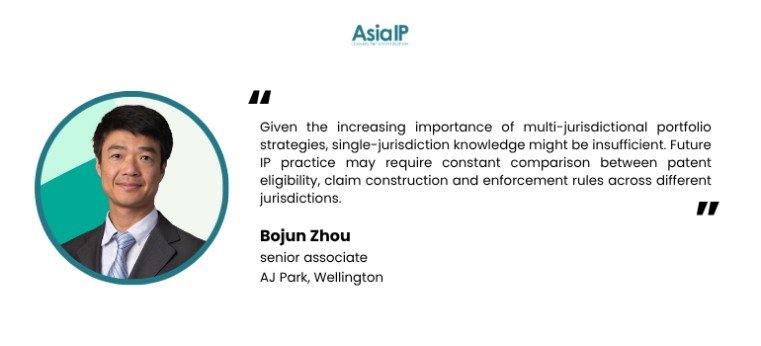
IP professionals should also have a comparative multi-jurisdictional legal judgement. “Given the increasing importance of multi-jurisdictional portfolio strategies, single-jurisdiction knowledge might be insufficient,” Zhou noted. “Future IP practice may require constant comparison between patent eligibility, claim construction and enforcement rules across different jurisdictions. Particularly, IP professionals must have up-to-date expertise in emerging IP subject matter by continuously tracking evolving regulations governing, for instance, AI-generated inventions and algorithmic trade secrets across different jurisdictions.”
They should also have a knack for IP financing. “As IP assets will transform into core commercial instruments, IP professionals will gain a competitive edge if equipped with supplemental skills in IP financing comprising IP pledging, IP valuation, IP securitization, cross-border licensing and assignment negotiations, and IP due diligence in mergers and acquisitions.”
Lastly, a cross-cultural strategic communication. “Taking Asia and Oceania, for example, bridging the commercial priorities of Asian innovators with Oceania market requirements remains a human skill that AI cannot navigate alone. A profound comprehension of not only legal and commercial but also cultural differences between the Oceania markets and the Asian markets will be increasingly important for IP professionals in both jurisdictions to communicate with clients efficiently, build relationship-based ecosystems and develop cross-cultural strategies,” Zhou said.
For de Guzman, lawyers need to be technologically fluent and data literate. “One doesn’t necessarily need to code, but you absolutely must understand how the technology works. You cannot cross-examine an expert witness on algorithmic bias, draft a software patent or negotiate a tech-transfer agreement if you don’t understand the underlying architecture. If a client explains their cloud-based SaaS infrastructure and your eyes glaze over, you will lose that client.”
Lawyers must also develop minimal business acumen. De Guzman said that clients won’t pay premium rates to lawyers to just quote the law – they can ask an AI for that. “They need you to understand their balance sheet. If a tech startup is looking to get acquired, the IP lawyer needs to conduct IP due diligence to prove to the buyers that the startup actually owns its source code and data sets. You need to understand IP as leverage for mergers, acquisitions and venture capital funding.”
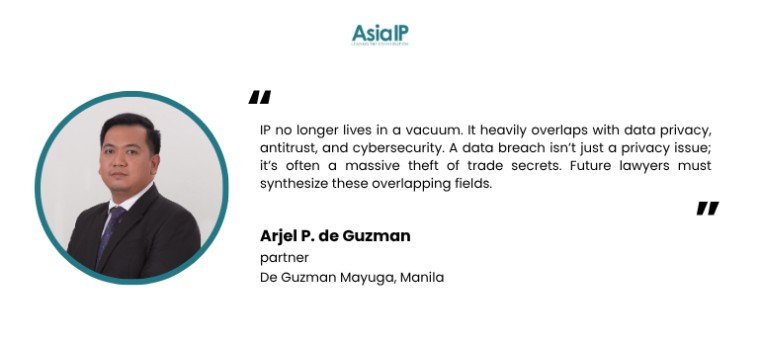
Lawyers must also develop interdisciplinary problem-solving skills. “IP no longer lives in a vacuum,” he said. “It heavily overlaps with data privacy, antitrust and cybersecurity. A data breach isn’t just a privacy issue; it’s often a massive theft of trade secrets. Future lawyers must synthesize these overlapping fields.”
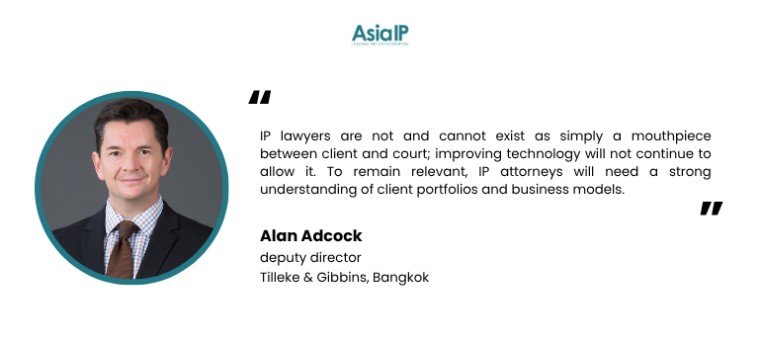
Adcock added: “IP lawyers are not and cannot exist as simply a mouthpiece between client and court; improving technology will not continue to allow it. To remain relevant, IP attorneys will need a strong understanding of client portfolios and business models, both to better anticipate the costs and benefits of potential litigation and to understand what needs can and cannot be met by a given client’s in-house team.”
Advice for young professionals
Zhou listed three pieces of advice for young IP professionals.
- Step outside the comfort zone. Remaining confined to the comfort zone of conventional patent drafting and/or filing work may erode one’s competitive edge in the long run. Proactively participating in future-oriented strategic projects including complex freedom-to-operate analysis, global portfolio design and IP financing is beneficial for career development.
- Embrace technological progress. Resisting technological change will yield no benefit and risk obsolescence by specialized AI tools. It is critical to evolve with the times by shifting one’s mindset to embrace emerging specialized AI tools and prioritizing building skills in identifying AI hallucinations.
- Carve out a specialized market position. Distinguishing yourself in the IP industry may provide a resilient career path; for example, developing a distinct professional position, such as a specialized Asia-Oceania cross-border IP liaison, to stand apart from commoditized conventional IP services.
Adcock says: “Be intellectually curious and learn to be who your client needs you to be; lawyering is roughly 70 percent business and interpersonal skills and 30 percent legal principles. Study the ‘greats’ – the largest businesses in each sector have developed strong models to protect their IP; adopt their strengths and learn from their mistakes lest you make your own.”
He also says IP professionals must network, network, network. “IP law is a comparatively small specialty, and building connections with others in the field is a requirement not just for a more enjoyable career but also for success. When in-house attorneys go looking for a firm to take on their matter, they don’t rely on academic publications or rankings. They call who they know well and who they trust to understand and protect their interests. Be that person.”
De Guzman said:
- Stop just being a lawyer – become an industry insider. If you want to handle IP for the tech industry, go to startup pitch nights, not just mandatory continuing legal education (MCLE) seminars. If you want to handle entertainment IP, understand how streaming algorithms and music publishing splits actually work. Speak your clients’ language.
- Embrace legal tech. Do it immediately. Do not fear AI – use it. Start using AI tools for document review, legal research and drafting basic contracts today. The lawyers who lose their jobs to AI will be the ones who refuse to use it, replaced by the lawyers who do.
- Master the administrative and alternative dispute machinery. Traditional court litigation in the Philippines can be agonizingly slow. Learn how to effectively use IPOPHL’s Bureau of Legal Affairs and its IP Rights Enforcement Office. Mastering mediation, arbitration and rapid administrative remedies will make you infinitely more valuable to a business that cannot afford to wait five years for a traditional case decision.
- Find your niche early. Don’t just be a “general IP lawyer.” Become the go-to expert in something specific: AI copyright liability, fintech patent strategies or geographical indications for local products. Deep, specialized expertise is immune to automation.