The U.S. and China are increasingly enforcing parallel IP rules, creating new challenges for global tech firms. Cathy Li examines how these parallel systems are forcing firms to rethink strategies and navigate dual risks in a complex global market.
The United States International Trade Commission (ITC) conducts Section 337 investigations, one of the country’s most powerful mechanisms for enforcing intellectual property rights. These proceedings, though not widely known to the public, are highly significant in corporate and legal circles because they can block infringing products from entering the U.S. market.
A prominent example is the dispute between medical technology company Masimo and Apple over pulse oximetry technology in the Apple Watch. The ITC determined that certain Apple Watch models infringed upon Masimo’s patents, leading to exclusion orders that barred those devices from entering the U.S. market and sparked ongoing litigation.
In November 2025, a California jury separately awarded Masimo US$634 million in damages for patent infringement, highlighting how Section 337 actions, combined with related court proceedings, can significantly disrupt even the largest global corporations.
The jury sided with Masimo, finding that features like the Apple Watch’s workout mode and heart rate alerts violated the company’s patent rights.
Apple responded with a statement, saying it disagrees with the decision and plans to appeal. An Apple representative noted that Masimo has filed numerous lawsuits against Apple over the past six years, asserting more than 25 patents – most of which were deemed invalid by the court. The representative added that the single patent involved in this case expired in 2022 and pertains to older patient-monitoring technology.
Meanwhile, Masimo described the verdict as a major victory in its efforts to safeguard its innovations and intellectual property. This lawsuit is part of a broader dispute between Apple and Masimo, which has accused Apple of poaching employees and misappropriating its pulse oximetry technology for use in Apple Watches.
The conflict previously led a U.S. trade tribunal to ban imports of Apple’s Series 9 and Ultra 2 smartwatches in 2023 after determining they infringed Masimo’s patents.
The two fronts
In light of mounting China-U.S. trade tensions, economists have intensified their analysis of protectionist tariffs and policy remedies on both countries. Notable studies such as Fajgelbaum et al. (2024) highlight the reallocation of global trade flows and welfare effects following tariff hikes during the 2018-19 trade war.
As the U.S. has shifted toward a more protectionist stance, its focus has tilted increasingly toward technology-intensive industries, such as semiconductors, medical devices and advanced electronics. Though U.S. President Donald Trump is widely blamed for his imposition of tariffs during both his first and second terms, the Biden administration continued most first-term Trump tariffs. Research from the World Bank (2023) indicates China’s share of U.S. imports fell from 22 percent in 2017 to around 16 percent by 2022, signalling both decoupling trends and evolving supply chain strategies.
Section 337 of the Tariff Act of 1930 is a central pillar of U.S. trade remedy legislation. It authorizes the ITC to investigate imported goods for infringement of U.S. intellectual property rights – including patents, trademarks, copyrights and mask works – and impose exclusion or cease‑and‑desist orders to halt infringing imports.
In 2024, Section 337 cases continued to concentrate overwhelmingly on patents: utility patents accounted for 89 percent of new investigations, while design patents comprised 11 percent; trademark and copyright cases represented 5 percent each. The most frequently targeted products remained high‑tech: semiconductors, computer and telecom devices, pharmaceuticals and medical instruments.
China’s parallel enforcement framework
China has now introduced its own mechanism resembling Section 337. In March 2024, the State Council issued the Regulations on the Handling of Foreign-Related Intellectual Property Disputes, which took effect on May 1, 2024. These rules include provisions for investigating IP violations in imported goods, echoing the ITC’s approach. Chinese companies have historically been frequent respondents in ITC cases, accounting for a significant share of investigations in recent years. Analysts view China’s new regulations as a strategic move to strengthen its IP enforcement and potentially reshape global supply chains.
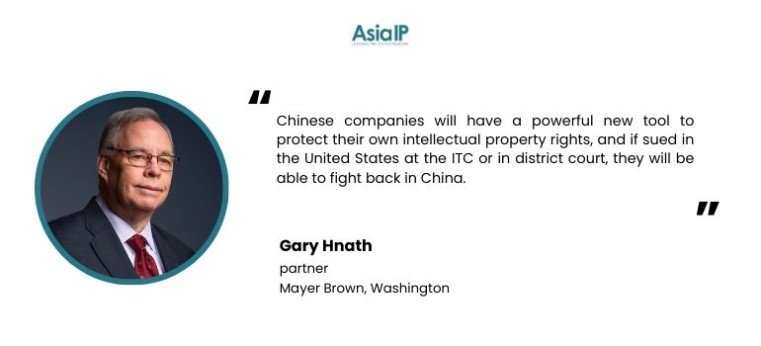
“A commission order can impact a company’s access to the U.S. market for many years, and even if the U.S. market is not significant today, it could be important in the future. To the extent a company’s global supply chain depends on products in the U.S., an ITC order may have effects beyond just U.S. sales,” said Gary Hnath, a partner at Mayer Brown in Washington.
Even when an exclusion order is narrowly defined, the requirement for a company’s products to undergo inspection at the U.S. border can significantly disrupt business operations. For this reason, Chinese firms should weigh these considerations carefully when deciding whether to contest a case before the ITC.
The emergence of parallel enforcement systems in the U.S. and China means intellectual property disputes can now affect supply chains in both jurisdictions. A redesign made to comply with a U.S. exclusion order may still face scrutiny under Chinese customs enforcement. As a result, businesses must consider the possibility of enforcement actions in both markets when planning supply chain strategies and product designs.