


Harnessing investor potential in Pakistan
31 October 2025

Investors in Pakistan are getting new support through pro bono patent services under the Investor Assistance Program. Excel V. Dyquiangco discusses how, despite some costs, the initiative encourages innovation and a broader shift towards IP participation.
Pakistan has launched a new Investor Assistance Program (IAP) to bolster innovation by providing local inventors with pro bono legal support for navigating domestic and international patent systems. This initiative aims to unlock the nation’s creative potential by removing barriers to securing intellectual property rights. The programme comes as Pakistan continues to address long-standing challenges in its IP landscape, including weak enforcement, counterfeiting and digital piracy, which remain primary concerns despite ongoing efforts to strengthen the framework under the Intellectual Property Organization of Pakistan (IPO-Pakistan).
With this move, Pakistan is beginning to explore advanced technologies to modernize its enforcement capabilities. The potential use of artificial intelligence to detect infringements and streamline IP protection is a key area of interest. Although in its early stages, this exploration into AI-powered solutions signals a forward-thinking approach to safeguarding innovation in the digital age.
To qualify for the programme, inventors must reside in an IAP-participating country, such as Pakistan, and demonstrate a basic understanding of the patent system. They must also meet defined financial thresholds to be considered “under-resourced.” For individual inventors, annual income must be below PRs2.5 million (US$8,800) for local patent filings and below PRs4 million (US$14,000) for international filings. For registered startups and small- and medium-sized enterprises, the annual revenue must be below PRs7 million (US$24,600) for local filings and below PRs10 million (US$35,200) for international filings.
Moreover, the invention must appear to be novel, inventive and industrially applicable, with potential for commercialization.
“The pro bono legal assistance being offered typically includes guidance in drafting the patent specification, preparing and filing patent documents, and navigating the application process, including correspondence with the patent office,” said Samina Naz Siddiqui, a patent associate at Bharucha & Co. in Karachi. “However, the exact scope of services varies case by case, depending on the agreement between the volunteer and the inventor. This means support may range from domestic assistance to more extensive help, though international filings may be less common unless specifically agreed upon.”
Aside from Pakistan, the IAP also offers pro bono patent assistance not only for domestic filings but also in select international jurisdictions, primarily through the Patent Cooperation Treaty system. The availability of such support is determined by several factors, including the presence of qualified volunteer patent professionals authorized to practice in the covered jurisdictions, the commercial potential of the invention in those markets and coordination between the World Intellectual Property Organization (WIPO) and national IP offices.
Currently, the IAP also supports filings in participating countries, as well as in jurisdictions that are party to the European Patent Convention and the United States, however, subject to the availability of required volunteer representation and prior coordination.
“For Pakistani inventors, seeking patent protection abroad exposes them to additional complexities,” said Sana Shaikh Fikree, counsel at Vellani & Vellani in Karachi. “These include navigating unfamiliar legal frameworks, complying with specific procedural and language requirements and managing significantly higher costs, such as official fees and translation expenses and other filing-related expenses, all of which are to be borne by the inventors themselves. The IAP does not cover these disbursements.”
Navigating the complexities
Like many other initiatives, the IAP may also face some challenges. According to Fikree, from Pakistan’s perspective, one of the most significant practical hurdles in implementing the IAP is the limited awareness and understanding of the patent system among local innovators, particularly those from rural areas.
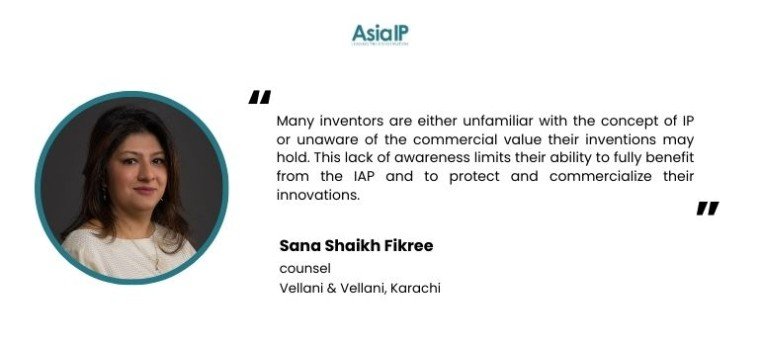
“Many inventors are either unfamiliar with the concept of IP or unaware of the commercial value their inventions may hold,” she said. “This lack of awareness limits their ability to fully benefit from the IAP and to protect and commercialize their innovations. To address this, IPO-Pakistan, in collaboration with WIPO, has launched targeted capacity-building initiatives, including multilingual workshops and accessible educational resources aimed at explaining the patent process.”
Another key challenge is the relatively small pool of qualified patent professionals in Pakistan who are well-versed in both domestic and international filing procedures under the IAP framework.
Moreover, while the IAP provides pro bono legal assistance for patent-related services, applicants are still responsible for covering associated expenses, such as official filing fees, translation costs and administrative charges. These financial burdens represent significant barriers for low-income inventors unless additional fee-reduction mechanisms are introduced.
Still, Fikree said, that beyond legal support, the participation of Pakistani innovators in the IAP has the potential to drive a meaningful cultural shift in the country’s innovation landscape. “By equipping inventors with tools to protect and commercialize their ideas, the programme encourages broader engagement in the intellectual property system and helps build investor confidence in locally developed technologies. Moreover, by strengthening patent literacy and linking inventors to professional networks, effective implementation of the IAP can serve as a catalyst for technology transfer, stimulate entrepreneurship and contribute to long-term economic development,” she said.
For Siddiqui, influencing the broader ecosystem of local innovation and investment in Pakistan is by expanding access to the patent system for financially under-resourced inventors, startups and small businesses. The IAP’s pro bono legal services help level the playing field and democratize innovation.
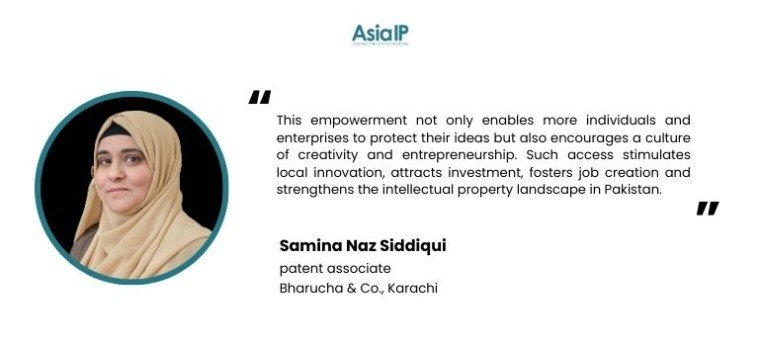
“This empowerment not only enables more individuals and enterprises to protect their ideas but also encourages a culture of creativity and entrepreneurship. In the broader context, such access stimulates local innovation, attracts investment, fosters job creation and strengthens the intellectual property landscape in Pakistan,” she said. “Over time, this can contribute to building a more vibrant, inclusive and knowledge-driven economy.”