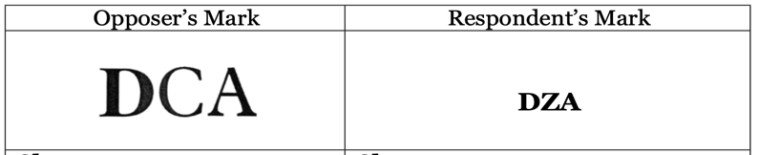
The trademarks “DCA” and DZA” essentially cover power tools being sold in the Philippines. Are they confusingly similar?
On April 20, 2026, in the opposition case filed by Jiangsu Dongcheng Power Tools Co., Ltd. (China) against the Philippine corporation Sobelier (IPC Case No. C/2024/189) the adjudication officer of the Bureau of Legal Affairs (BLA) of the Intellectual Property Office of the Philippines (IPOPHL) issued a decision granting the opposition against the mark “DZA” for being confusingly similar with Dongcheng’s Philippine registered trademark “DCA”. Sobelier was Dongcheng’s distributor of its power tools branded DCA from 2013 to 2022. Upon said expiration, Sobelier found another supplier, Jiangsu Dazhong Electrical Co., also in China, which it claimed to be selling many products, including power tools, under the brand DZA. Sobelier claimed to have Dazhong assign the DZA mark to it and filed the subject application.
Applying the doctrine of idem sonans, the AO cited the case of Marvex Commercial Company vs. Petra Hawpia, where the Supreme Court held “Be that as it may, when two words are pronounced, the sound effects are confusingly similar”. Hence the AO ruled that the marks are confusingly similar, to wit:
“DZA and DCA bear close phonetic resemblance. In purchasing the goods covered by the marks, consumers may be misled or confused as to which product to elect, owing to the striking similarity in the sound, of the competing marks, especially considering that they are used on on identical or closely related goods. Phonetically, applying the rule on idem sonans which refers to the names that have the same or similar pronunciation, without the necessity of absolute identity, the marks in this case are likewise similar.” The registration of the mark “DZA” was therefore rejected due to the likelihood of confusion with the earlier trademark “DCA”.
On the issue of bad faith alleged by Dongcheng because of the parties’ past relationship, the AO explained and held that in the absence of clear and convincing evidence, mere knowledge of the trademark creation and registration of the earlier mark is not sufficient. This decision was appealed by Sobelier and is pending with the BLA director.