

Case review: Invalidation of trademarks on the basis of prior copyright.
30 October 2026
Trademarks take a seat of honour among other means of individualization being in the forefront when a new product enters a market. An eye-catching trademark excites consumers’ curiosity, thus turning into a tool to attract new clients. Striving to get more profit, companies do their best to develop designations that subsequently may grow into a brand with a respective reputation. However, sometimes market players carelessly decide to take advantage of existing creations, which may result in a conflict with owners of other intellectual property rights, for instance, holders of prior copyright.
Part IV of the Russian Civil Code regulates legislation on trademarks and among other provisions foresees the grounds for refusal and invalidation of trademarks. In particular, it stipulates that designations which are identical or confusingly similar to an object of copyright cannot be registered as trademarks without the consent of the copyright holder, provided that the rights to the relevant work arose prior to the priority date of the trademark which is sought to be protected. The restriction applies specifically to the following:
- The title of a work of science, literature or art known in Russia as of the date of filing an application for state registration of a trademark,
- A character or a quotation from such a work, or
- A work of art or a fragment thereof.
The exclusive right to works of science, literature and art that have been created and exist in some objective form outside the territory of the Russian Federation is recognized in Russia in accordance with international treaties to which the Russian Federation is a party, specifically the Universal Copyright Convention and the Berne Convention for the Protection of Literary and Artistic Works.
The Russian patent and trademark office conducts trademark examination both on absolute and relative grounds ex officio, but some grounds are excluded from the scope of review, which is the case with the provision mentioned above. If a copyright holder becomes aware of an application that reproduces or imitates his copyrighted object, it is possible to take a proactive approach at the time of trademark examination procedure and file an observation letter (the so-called “informal opposition”) in order to draw the examiner’s attention to the existing prior copyright. The arguments set forth in the observation letter are taken into account by the examiner when making a decision regarding the mark.
Alternatively, if the infringing mark is already registered, Russian legislation provides that an interested person may initiate an invalidation action against its registration within the whole term of validity of the trademark.
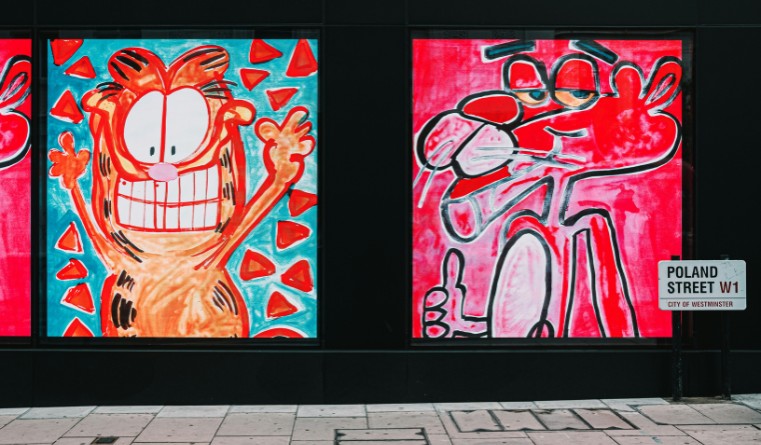
A nice example of a successful invalidation action is a case in which American film production companies Metro-Goldwyn-Mayer Inc. and Metro-Goldwyn-Mayer Pictures Inc. disputed registration of trademark “Рекламное агентство РОЗОВАЯ ПАНТЕРА” (“Advertising Agency PINK PANTHER” in Russian) protected for services of Class 35. In this case, the companies argued, in particular, that the disputed trademark was identical to the title of a famous work of art – The Pink Panther, a series of comedic detective films about the adventures of Inspector Jacques Clouseau, as well as to the name of the fictional character of the same name, the copyright to which is held by the companies. In support of their claims the companies submitted the copyright certificates and evidence of fame of The Pink Panther series among Russian consumers, which included customers’ reviews on the film, a report of news agency on publications concerning the film in the Russian press as well as publications in online media about the film, information from the Register of Film Distribution Certificates regarding the Pink Panther films.
As a result of consideration of the invalidation action the Russian PTO established that the companies could be recognized as interested parties, since they owned the U.S.-registered copyright to motion pictures (audiovisual work) under “The Pink Panther” name. Further, the Russian PTO indicated that the disputed trademark included individualizing element in the Russian language “РОЗОВАЯ ПАНТЕРА” (PINK PANTHER) that evoked the image of a fictional creature with a fanciful name that possessed a creative character, especially when used as the title of a work of art, such as a motion picture, or as the name of a character within that work. Additionally, the element “РОЗОВАЯ ПАНТЕРА” of the disputed trademark represented a direct Russian translation of the audiovisual work name The Pink Panther. Having evaluated numerous data about The Pink Panther motion pictures within the Russian segment of the internet and having analyzed the submitted evidence the Russian PTO came to the conclusion that The Pink Panther films were famous among the Russian consumers and the individualizing element of the disputed trademark was identical to the name of the motion picture and its character, exclusive right to which emerged long before the priority date of the disputed trademark. Moreover, the Russian PTO took into account that the companies had not granted consent to the trademark holder to registration of the disputed mark. Consequently, trademark “Рекламное агентство РОЗОВАЯ ПАНТЕРА” was invalidated.
Another case of a trademark dispute that involves copyright infringement is an invalidation action initiated against the  trademark. In this legal action the claimant indicated that his company owned a copyright to a font among other grounds for invalidation. This font was used in all trademarks that belonged to the claimant, for example,
 , and in his opinion the holder of the disputed trademark had imitated this specific font.
In the course of the dispute examination the Russian PTO analyzed and assessed the filed evidence in support of copyright ownership and came to the conclusion that that the claimant was a holder of the copyright to the font, while the owner of the disputed trademark had not provided information regarding the independent development of the font or the acquisition of a ready-made font from any other party. As such there were no grounds to assume that the font had been created by the disputed trademark’s holder on his own.
Further, the visual comparison of letters used in the marks and showed that they were obviously similar to the extent of confusion.
Moreover, the Russian PTO took into account the results of the opinion poll according to which 70 percent of respondents perceived the font of the disputed trademark as imitating the font of the trademarks of the claimant. Therefore, the Russian PTO considered the arguments on imitating the font that was a subject of the copyright to be a reasoned ground for invalidating the trademark.
Both reviewed cases are examples of successful defense of the exclusive right to different works: the title of the audiovisual work and the name of its character and the work of art in the nature of the font. Comparing two legal actions it seems important to highlight the difference between them, which lies in the necessity to prove fame of a work of science, literature, or art whose title, character or quotation thereof reproduced in the disputed trademark, which is the case with “The Pink Panther” copyright. At the same time there is no such a requirement for work of art or a fragment thereof, which is reflected in a dispute regarding imitation of the font.
To sum up, from a perspective of a future trademark owner it is reasonable to at least surf the internet to check if there are any obvious copyrights that a trademark may interfere with; and from a perspective of a holder of a copyright, monitoring of a trademark registry for possible infringing filings or registrations is advisable.
About the author

Law firms