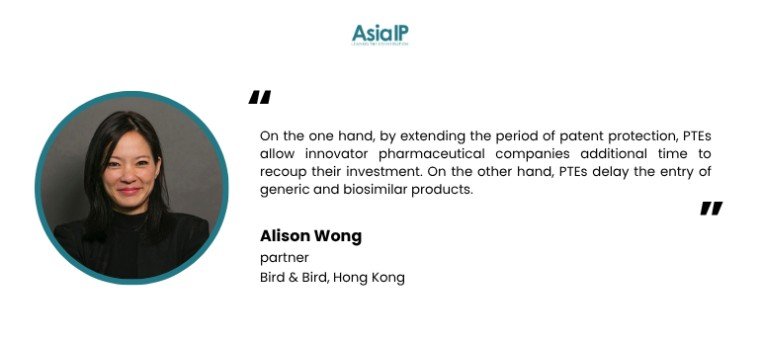
Still, according to Alison Wong, a partner and head of life sciences and healthcare sector group at Bird & Bird in Hong Kong, PTEs can have both positive and negative effects on competition in the pharmaceutical market. “On the one hand, by extending the period of patent protection, PTEs allow innovator pharmaceutical companies additional time to recoup their investment,” she said. “On the other hand, PTEs delay the entry of generic and biosimilar products. As a result, price competition may be postponed as lower-cost alternatives may only become available later, and originator companies may be able to maintain market share for a longer period. In effect, the ‘patent cliff’ is deferred.”
Wong said that critics also argue that the value of extended exclusivity may incentivize some patent holders to adopt strategies aimed at prolonging market exclusivity. She listed examples of such practices:
- Patent evergreening: Obtaining additional patents covering secondary uses of a pharmaceutical product – such as new formulations, dosage strengths or methods of use – which may extend market exclusivity and delay generic competition beyond the expiry of the core patent.
- Product hopping: Shifting patients from an existing drug to a newer version protected by later-expiring patents before the original product loses exclusivity. The newer product often contains the same active ingredient but differs in formulation, dosage or dosing schedule.
- Patent thickets: Building extensive portfolios of overlapping patents around a pharmaceutical product, which may increase the costs and complexity of generic market entry.
- Pay-for-delay settlements: Settling patent disputes through payments or other consideration from an originator company to a generic or biosimilar manufacturer in exchange for delayed market entry, potentially reducing competition.
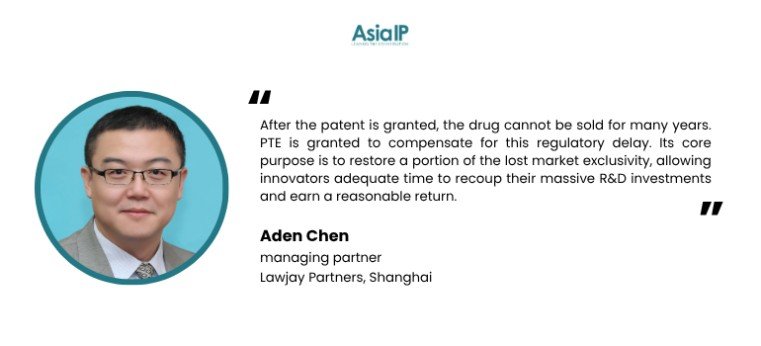
Chen agreed with Wong, saying that one such example of its positive impact is the Hatch-Waxman Act and other similar patent linkage systems, which were a deliberate balance. “It rewards innovators with PTE, but simultaneously creates the Abbreviated New Drug Application pathway, which allows generic manufacturers to rely on the brand’s clinical data. This enables generics to launch immediately upon patent expiry, fostering robust price competition,” he said.
As for its negative impact, he noted: “In South Korea, critics have pointed out that PTE systems have allowed foreign innovators to dominate the market and significantly delay domestic generic production, burdening the national health insurance system.”
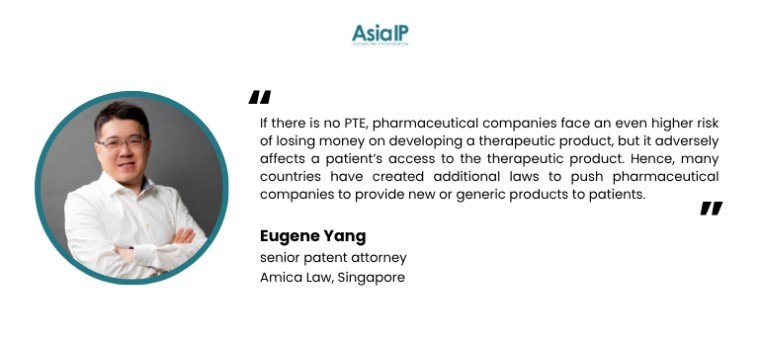
Eugene Yang, a senior patent attorney at Amica Law in Singapore, explained that a PTE allows the patentee to block other companies from supplying the same therapeutic product in what is known as a generic product.
“Pharmaceutical products are unique due to the regulatory control,” he said. “Companies cannot just launch a new competing product, as it has to be shown that the new product is better than the existing product, unlike typical products where competitors can launch products with different quality and price. A generic product is significantly cheaper to develop as it typically does not need to conduct new clinical trials.”
Availability and affordability of medicines
In terms of medicines, PTEs may affect the affordability of medicines in the short term by delaying the entry of lower-cost generic and biosimilar products, Wong noted. “Patients and healthcare systems may therefore continue to bear higher pharmaceutical costs during the extended exclusivity period,” she said.
At the same time, the patent system operates on a fundamental bargain: in exchange for a limited period of exclusivity, patent holders must publicly disclose their inventions and the technical information underlying them, she said. “Once patent protection expires, generic manufacturers can rely on this publicly available information – together with applicable regulatory pathways – to develop and market generic versions of the medicine, ultimately improving patient access to more affordable treatment options,” Wong added.
“PTEs are intended to compensate innovators for the effective patent life lost during the lengthy process of drug discovery, development and regulatory review. Therefore, PTEs help preserve the incentives needed to develop innovative therapies. From this perspective, while PTEs may postpone access to lower-cost alternatives for a limited period, they can also support the long-term availability of innovative medicines. For patients, this may translate into access to novel therapeutic modalities, first-in-class or best-in-class treatments, and new therapies for diseases where limited or no effective treatment options previously existed,” she explained.
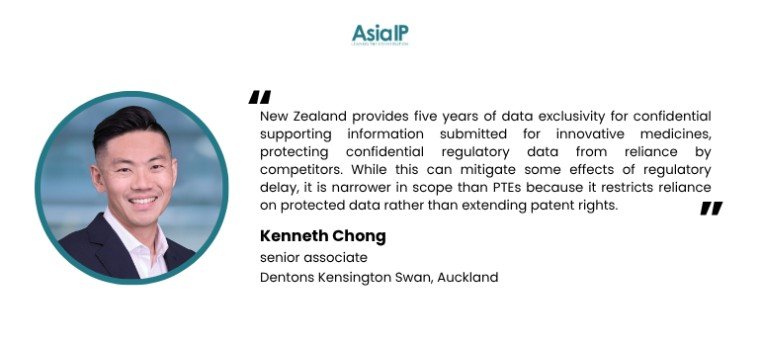
Chong said that PTEs can influence both affordability and availability by extending the period during which lower-cost generic or biosimilar alternatives are excluded from the market. “During this period, medicine prices may remain higher than they would under competitive conditions,” he said. “Once exclusivity ends, generic or biosimilar entry typically improves availability and places downward pressure on prices.”
He added: “However, the real-world impact on patients depends heavily on the broader healthcare funding framework. Public subsidy, reimbursement mechanisms and procurement policies can significantly moderate the effect of PTEs on availability and affordability of medicines. For example, in Australia, the Pharmaceutical Benefits Scheme subsidizes a large proportion of prescription medicines, reducing out-of-pocket costs for patients and mitigating the immediate pricing impact of PTEs.”
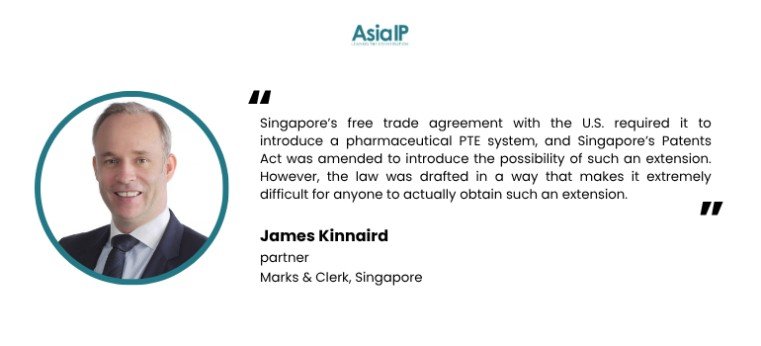
Kinnaird said: “As other companies are barred from selling the same drug, the price of the drug is set by the patent originator, so the price is usually set as high as the market in question will bear (taking into consideration other innovator or generics medicines in the same space). Once the patent term extension expires, then the price for the drug will normally start to fall as generics manufacturers enter the market and compete for market share.”
Balancing rights and medicines
According to Chen, balancing the private right of a patent holder against the fundamental human right to health is a challenge in pharmaceutical IP governance. She added that key mechanisms have been implemented to address this challenge, including:
- Setting strict upper limits: Legislatures have capped the extension (maximum five years) and the overall effective post-approval term (no more than 14 years) to prevent indefinite monopolies.
- Limiting eligible patents: Rules have been enacted that allow only one patent extension per drug product, preventing companies from using “patent thickets” to extend exclusivity through serial secondary patents.
- Permitting Bolar exemption: Legal exceptions have been stipulated allowing generic companies to conduct research and prepare regulatory submissions during the patent term, so they can launch immediately upon patent expiry.
Chen said that other devices may be considered:
- Enhancing patent linkage and opposition systems: Legal and administrative rules should be set up for stricter drug patent registries in patent linkage system and expedited legal and administrative mechanisms for generics to challenge patents before they expire.
- Utilizing TRIPS Agreement (Agreement on Trade-Related Aspects of Intellectual Property Rights) flexibilities: Governments may streamline the pathway of compulsory licensing to authorize third parties to produce a patented drug without the owner’s consent during public health crises and allowing parallel importation of the same patented drug from countries where it is sold at significantly lower prices.
- Exploring alternative innovation models: Societies may explore more non-patent-based incentives – such as government R&D grants, public-private partnerships, milestone prizes and other mechanisms that delink drug prices from R&D costs – to ensure essential medicines are treated as public goods.
Kinnaird noted that the key to the patent system is that, in return for the full disclosure of an invention, the patentee gets a right to stop others working their invention for a period of time. “This is generally seen to work across technologies, as it gives a limited time period for an innovator to develop and benefit from their invention – and for many fields, that window may only exist for five to 10 years after filing the patent application,” he said.
For pharmaceuticals, the situation is different, as the patents will often be kept in force for the full 20 years – and beyond if a patent term extension is granted. “The main policy debate therefore is how to balance the needs of patients against providing a suitable incentive to companies to continue discovering and developing medicines. There is no easy answer as to what the right balance is,” he said.