

India Urged to Triple R&D Investment
04 February 2026
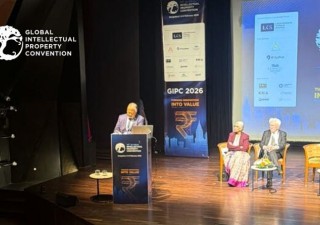
At a opening of the Global Intellectual Property Conference (GIPC) in Bangalore, India this week, policymakers, scientists, and intellectual property experts issued a strong call for India to dramatically scale up its research and development (R&D) investment and indigenous innovation capabilities. Speakers argued that the country’s current spending—just 0.6–0.7% of GDP—is insufficient for a nation of India’s scale and aspirations, especially when compared to the 2.5% invested by the United States and 2.7% by China. The panel recommended raising the figure to at least 4% of GDP to secure India’s strategic and technological future.
Opening the session, Pravin Anand, managing partner at Anand & Anand in India highlighted the need for faster legislative responsiveness, particularly in international forums where policies can rapidly shape or restrict technological development. Anand highlighted how objective decision‑making backed by metrics, expert analysis, and AI‑based modelling could help Indian institutions respond more swiftly. Anand also highlighted that India is spending primarily on basic sciences, not on applied sciences., and that if we increase spending on R&D, the our direction has to change. Education, he emphasized, will be crucial in neutralizing bias and ensuring informed decision-making across sectors.
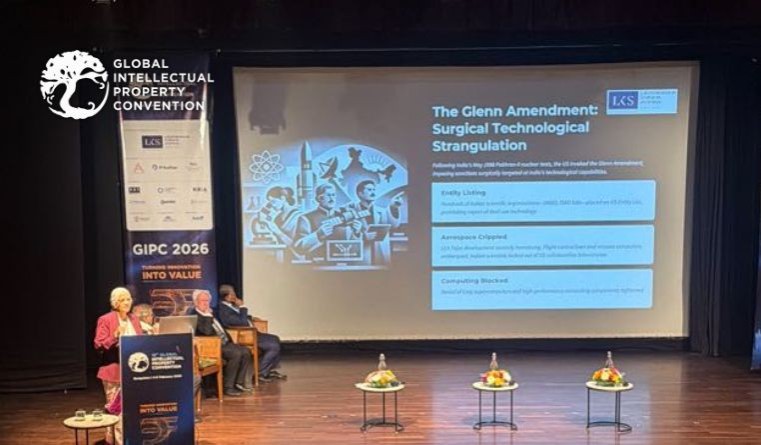
Malathi Lakshmikumaran, executive director at Lakshmikumaran & Sridharan in Delhi, India, traced India’s journey of technological self‑reliance. She recounted historical episodes—from nuclear sanctions to space technology restrictions—that ultimately pushed India to innovate under pressure. Icons such as Dr. Homi Bhabha and Dr. Vikram Sarabhai were credited for laying the foundations of the country’s atomic energy and space programs, proving that externally imposed barriers can catalyse internal scientific breakthroughs.
The presentation drew from pivotal geopolitical moments, including the denial of a cryogenic engine in the 1990s and GPS access restrictions during the Kargil conflict, to illustrate why strategic autonomy in technology is not optional but essential. As global technology standards increasingly shape markets and governance, India’s limited presence in standard‑setting bodies was identified as a major strategic gap.
A substantial portion of the session focused on India’s IP and R&D landscape, which speakers described as fragmented and underfunded. India’s massive outflow of royalty and licensing fees—paid largely to foreign technology owners—was cited as a key economic concern. To address this, experts recommended establishing an RLI (Research‑Linked Incentive) scheme, mirroring the success of the existing PLI model but designed specifically to reward research-intensive investments. Agarwal pointed out that India’s GDP is about US$4 trillion and was spending only 0.6 to 0.7% of that small relatively small amount. Chinese GDP is approximately US$30 trillion so is spending 2.5% of $30 trillion. “We are spending a very small, meagre amount in absolute terms. How India can become a strong economic power on that?” he asked. “It's only through increased spending on R&D, which is required., and the entire IP ecosystem has to be strengthened through the creation of IP, through protection of IP, through enforcement of IP, through commercialization of IP and by raising awareness” he said.
Strategic sectors such as semiconductors, artificial intelligence, advanced batteries, and quantum computing were identified as areas where India must aggressively build IP portfolios. The government’s recent semiconductor manufacturing push was welcomed, but speakers noted that sustained success will depend on talent availability, long‑term R&D commitments, and reliable energy infrastructure. The indigenous anti‑drone technology program was cited as an example of how India can move beyond import substitution to become a global provider of high‑value strategic technologies.
The session concluded with a set of strong recommendations: setting clear national IP targets, increasing academic‑industry collaboration, establishing transparent frameworks for IP ownership, and significantly expanding government and corporate R&D budgets. Anand stressed the need to shift India’s scientific focus “from basic sciences alone to applied innovation,” emphasizing that the corporate sector must play a far larger role, and that education was essential to make this happen.
- Darren Barton, at the GIPC, Bengaluru, India