

Quality versus quantity
15 July 2025

An unusually high number of patent grants in India has sparked debate
Is India’s patent office sacrificing quality to meet Office Order 34’s disposal targets? Espie Angelica A. de Leon analyzes the surge in patent grants, expert opinions on quality and proposed policy reforms.
Is the Indian Patent Office granting more patents than it should?
In 2016, the Office of the Controller General of Patents, Designs and Trademarks, commonly known as the Indian Patent Office, issued Office Order 34. Among other directives, the order set a target of 30 disposed applications per month per controller, including abandoned cases. That translates to 360 disposals a year per controller.
Fast forward to 2023: As of March, the Indian Patent Office had 241 controllers. By May, this number had increased to 557. The office’s total number of patent grants for the year was 76,053, about 80 percent of processed applications and 149.4 percent more than the patent grants for 2022, as reported by the 2024 World Intellectual Property Organization (WIPO) IP Indicator Report. The office received 90,298 patent applications in 2023 – an increase of 13,230 applications over those recorded in 2022 – and was able to process 93,401 that year.
These numbers are remarkable, but they’ve also sparked concern as to the quality of the patents granted and rejected. The quality of these patent grants has been criticized by different high courts. Has India’s patent office been compromising quality over quantity to comply with Office Order 34?
High-quality and low-quality patents
First, what are high-quality and low-quality patents?
Manisha Singh, founder and managing partner at LexOrbis in New Delhi, summed it up: “A quality patent grant meets strict legal and technical standards, ensuring the invention is patentable, novel, inventive and industrially applicable, with clear claims that hold up in court. It also serves the public interest by offering full disclosure and a well-supported scope of claims in the specification. A quality patent is valuable to both the patentee and society, fostering innovation through.”

“[It must also] fuel economic development through commercialization and licensing and [must] ensure access to essential technologies and avoiding abuse of monopoly rights,” added Vaishali Mittal, a litigation partner and strategist at Anand and Anand in Noida.
Low-quality or weak patents often lack novelty or inventiveness and are more likely to be challenged or invalidated, reducing their overall value. For businesses, such patents discourage investments in research and development. For the innovation ecosystem, they deter genuine inventors from investing time and resources for their inventions. On a national scale, a reputation for weak patents is not exactly appetizing to foreign investors. In India’s case, it weakens its global standing as an innovation hub. “With no IP Appellate Board, it further burdens the already overburdened Indian courts with disputes over weak patents,” said Singh.
Quality versus quantity and Office Order 34
There is no question that high-quality patents are valuable – but where does quantity fit in? In the face of work backlogs besieging India’s IP office and the pressure to hasten patent disposals, how can patent quality and quantity work together without compromising one for the other? Or is one ultimately more important?
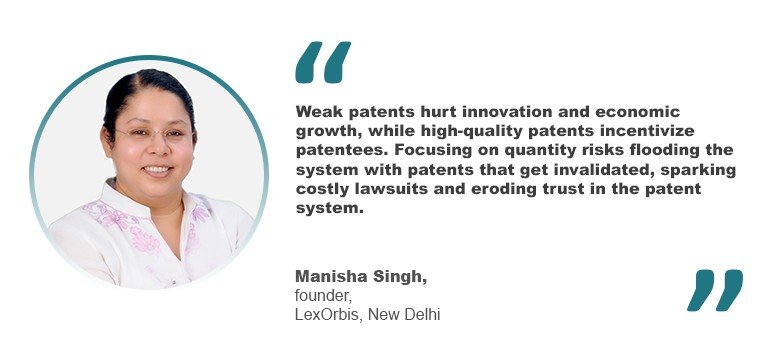
For Singh, quality is more important. “Weak patents hurt innovation and economic growth, while high-quality patents incentivize patentees. Focusing on quantity risks flooding the system with patents that get invalidated, sparking costly lawsuits and eroding trust in the patent system. That said, a steady flow of quality patents can show a thriving innovation scene as long as the review process stays rigorous,” she explained.
Singh believes Office Order 34 likely tipped the balance toward quantity over quality as far as the patent grants in 2023 are concerned. “The sharp rise in patent grants in 2023, with most applications approved, raises questions about quality. While this could mean better efficiency or more innovation, high court criticisms point to possible gaps in the examination process, likely due to pressure to meet disposal targets. The time examiners have for substantive tasks seems less, and this trend calls for a closer look to ensure quality is not taking a backseat in the process of clearing examination backlogs,” she said.
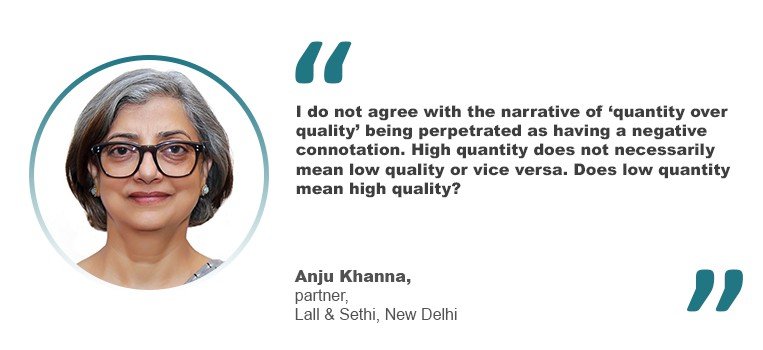
For Anju Khanna, a partner and head of patents at Lall & Sethi in New Delhi, quantity and quality are both important. “I do not agree with the narrative of ‘quantity over quality’ being perpetrated as having a negative connotation,” she said. “High quantity does not necessarily mean low quality or vice versa. Does low quantity mean high quality? However, if, say, 10 lakh [1 million] applications are filed, even if 1 lakh [100,000] are ‘good quality’ patents, it is very good for the economy. The global metric, I believe, is 6 percent of applications being commercialized,” she noted.
Khanna disagrees that the Indian Patent Office favoured the quantity of granted patents over the quality of these patents in 2023. “The bar to patentability in India is already high, especially making it difficult to catzch the low-hanging fruit,” she pointed out. “In any case, the patent office was clearing the backlog.”
She added that the number of patent applications filed and granted in India is actually low compared to its population and needs.

Mittal and Rachna Bakhru, a partner at RNA, Technology and IP Attorneys in Gurugram, agree that quantity and quality are both equally important.
According to Bakhru, a huge quantity of patents filed or granted may be seen as a sign of a country’s innovative capacity and technological advancement. “It can boost national pride and attract foreign investments. The higher number of patents can lead to increased commercialization of technologies, fostering economic growth and job creation,” Bakhru stated.
But, if there are no mechanisms to ensure quality, “volume alone risks diluting the value of the patent system,” Mittal noted.
According to Bakhru, the sharp rise in patent grants in 2023 may be attributed to several government initiatives. Fees for women, startups, educational institutions and others were discounted to fuel more filings from these sectors. Awareness programmes were also mounted. “Earlier, the ownership of IP was limited to big companies with financial resources to protect their IP rights. However, the government’s initiatives led to a significant increase in national filings, mostly by startups, small entities and educational institutes,” Bakhru shared. India has one of the largest startup ecosystems in the world.
Hundreds of new examiners and controllers were recruited. In 2014, the Patent Office had 431 staff members. By 2024, the number ballooned to 1,433. “This expansion wasn’t just about numbers,” Mittal emphasized. “It was tied to improved training programs, process reengineering and upgraded IT infrastructure, such as automation tools and electronic filing systems.” These modern tools are being used to assist in document analysis, prior art search and workflow management.
Furthermore, India maintains robust checks and balances. “A dual-layered opposition system – pre- and post-grant – allows any stakeholder to challenge patents they believe are weak or ineligible,” Mittal explained.
As active enforcers of patent standards, the courts are doing their part by often striking down weak patents and holding the Indian Patent Office accountable.
Lastly, the globalization of innovation is playing out its role with the surge in filings from tech titans, such as Google, Qualcomm, Huawei, Nokia, Apple, Google and other major brands. This development clearly shows multinational enterprises trust India when it comes to IP protection.
Mittal disclosed that India’s 2023 WIPO Patent Cooperation Treaty (PCT) Quality Subgroup submission confirmed that quality has remained a priority via internal quality audits, feedback loops and a dedicated quality assurance team.
“These factors indicate that while patent numbers are growing, quality has remained at the centre of policy execution,” Mittal said. “Hence, the 2016 order acted as a catalyst, sparking structural improvements rather than undermining patent examination depth.
For Pankaj Soni, a partner at Remfry & Sagar in Gurugram, the issue is more complex than the quantity-versus-quality narrative. To provide context, he said the following must be considered: that patent quality remains essential, increased output is often a response to practical needs and balancing trade-offs is a natural part of developing any IP regime.
“Historically, India has faced considerable scrutiny regarding the slow pace of patent examinations and a large backlog, viewed as hindering innovation and discouraging foreign investments. In response, the IP office has implemented several reforms. These efforts were explicitly intended to enhance efficiency and respond to both domestic and international expectations – not to compromise on quality. Thus, it may not be entirely fair to criticize these initiatives now that tangible progress is evident,” Soni said.
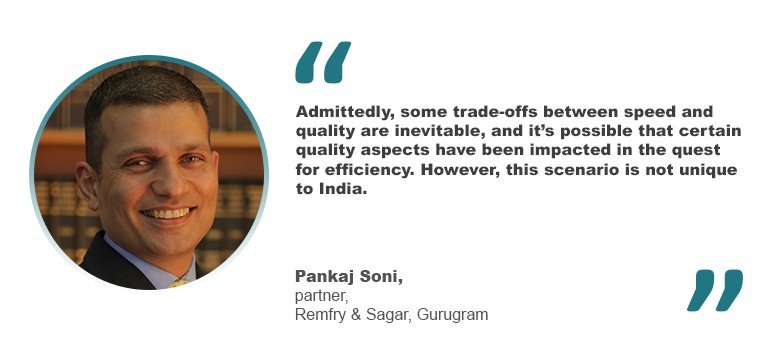
“Admittedly, some trade-offs between speed and quality are inevitable, and it’s possible that certain quality aspects have been impacted in the quest for efficiency. However, this scenario is not unique to India,” he revealed.
Patent offices in other jurisdictions are dealing with these same issues. As reported by the United States Patent and Trademark Office (USPTO), a noticeable percentage of office actions in fiscal year 2022 did not fully meet statutory compliance standards. Meanwhile, a survey conducted by the European Patent Office (EPO) in 2021 found that roughly 20 percent of respondents were dissatisfied with the consistency and timeliness of its patent examinations, among other aspects.
“These global examples demonstrate that quality challenges in patent examination are universal, not exclusively associated with higher processing speeds. It is also uncertain whether a slower processing rate would necessarily result in higher-quality patents,” Soni noted.
Policy changes for patent quality and quantity
To ensure patent quality is not – and will not be – compromised, more policy changes are needed.
“To begin with, the Patent Act needs amendments. It is stuck in the 1970s,” observed Khanna, “trying to solve 21st-century problems.”
Our interviewees propose these additional measures:
-
Ease strict disposal targets to give examiners more time to conduct more thorough reviews.
-
Strengthen the technical training of examiners to ensure consistent standards, with a special focus on fast-evolving sectors like artificial intelligence, genomics and climate tech.
-
Roll out transparent quality performance metrics, such as the proportion of patents successfully challenged, examination quality scores and litigated outcomes.
-
Introduce tougher quality checks, such as peer reviews, before granting patents.
-
Work with courts and industry to refine guidelines and address judicial concerns.
-
Promote judicial capacity-building to strengthen IP case law and reinforce the quality bar.
-
Benchmark quality against leading patent offices, such as the EPO, USPTO and Japan Patent Office, and participate actively in international quality forums.
-
Increase transparency by sharing detailed reasoning in patent decisions to build trust and accountability.
-
Support high-potential but under-resourced applicants, including business startups and universities. Provide mentorship and technical aid to startups. Offer legal and tech transfer support to universities.
-
Enhance public participation by encouraging third-party observations during the examination process and by creating accessible digital platforms for public feedback on pending applications.
There may be different perspectives on the quality-versus-quantity issue. But with the policy changes and measures outlined above, it’s clear there is still a lot of room for improvement in India’s patent system. If these policies were implemented, India may well be able to settle the quality-versus-quantity debate as far as patent grants are concerned, at least for the most part.