

Building digital defenses: Indonesia’s new framework for IPR protection in electronic systems
15 April 2026
Between 2019 and 2025, a total of 296 intellectual property rights infringement cases were reported, with trademark violations dominating the statistics, followed by copyright and patent infringements. Yet, these figures represent only the visible tip of the iceberg. They reflect reported cases, not the true scale of infringement in Indonesia. Many violations go unnoticed, unreported or unregistered, often because individuals and businesses are unaware of their rights or underestimate the importance of IPR protection. The rapid expansion of the internet has only intensified this challenge. Creativity now travels at the speed of a click, ideas, images, and content can be uploaded and shared instantly across digital platforms. But not everyone uses this accessibility responsibly. Some parties exploit it to misuse IPR, creating misleading impressions that their products originate from, are endorsed by or are affiliated with established brands or platforms.
Following this concern, on December 4, 2025, the Minister of Law (MOL) issued Regulation No. 47 of 2025 on the Handling of Intellectual Property Infringement Reports in Electronic Systems. This article highlights the key provisions of Regulation 47/2025, which introduces mechanisms for reporting IPR infringements in electronic systems that intellectual property owners in Indonesia should take into account.
Scope of IPR infringements in electronic systems
The regulation specifies IPR infringements conducted through an electronic system constitute a violation involving electronic information and/or electronic documents. IPR in this context covers, among others, copyrights, industrial designs, patents, integrated circuit designs, trade secrets, trademarks, geographical indications and communal intellectual properties.
This IPR infringement includes the production, sale, imitation, or distribution of any materials, creations, products, services and/or signs protected by IPR through digital or online platform, without the authorization of the relevant IPR owner or rights holder. Definitions of electronic information and electronic documents under Regulation are as follow:
|
Electronic Information |
Electronic Documents |
|
One or a set of electronic data, including but not limited to writing, sound, images, maps, designs, photographs, electronic data interchange, electronic mail, telegrams, telex, telecopy or similar forms, letters, signs, numbers, access codes, symbols or perforations that have been processed and have meaning or can be understood by a person capable of understanding them. |
Any electronic information that is created, forwarded, transmitted, sent, received or stored in analog, digital, electromagnetic, optical or similar forms, which can be seen, displayed and/or heard through a computer or electronic system, including but not limited to writing, sound, images, maps, designs, photographs or similar forms, letters, signs, numbers, access codes, symbols or perforations that have meaning or significance or can be understood by a person capable of understanding them. |
Who may submit an IPR infringement report and how to do it?
An IPR infringement report may be submitted by:
-
Owners who have been duly registered or recorded with the MOL through the Directorate General of Intellectual Property (DGIP); or
-
A license holder, provided that the relevant license agreement has been duly recorded with the DGIP.
The registration certificate or license recordation confirmation must be submitted to the DGIP while filing the report.
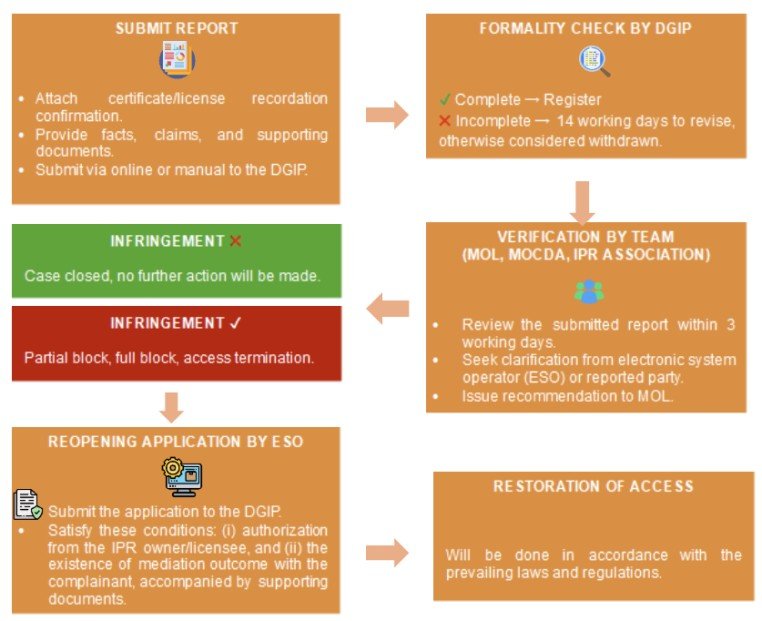
Meanwhile, the reporting procedure as regulated under Regulation is summarized as follows:
Conclusion
This regulation represents a pivotal development in Indonesia’s digital IPR enforcement landscape, establishing a structured and coordinated framework for the reporting, verification, and enforcement of intellectual property rights in electronic systems. By integrating multi-agency oversight, clear procedural mechanisms, and defined enforcement tools such as site closure and access termination, the regulation strengthens legal certainty for rights holders while clarifying the responsibilities of digital platforms and electronic system operators. Ultimately, this framework positions Indonesia to better protect innovation, creativity, and legitimate digital commerce in an increasingly interconnected online ecosystem in this digital era.
About the author

-preview.jpg)

Law firms