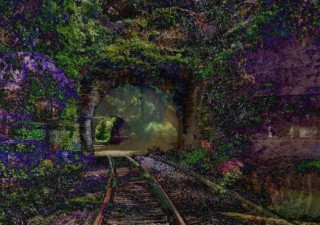


Delhi High Court to copyright office: Decide on Thaler application for AI artwork in eight weeks
20 April 2026

On April 9, 2026, India’s Delhi High Court ordered the Registrar of Copyright to come up with a decision regarding American computer scientist Stephen Thaler’s copyright application for an AI-generated artwork, within eight weeks from the date of the hearing on April 27, 2026.
The artwork A Recent Entrance to Paradise was created using the artificial intelligence model DABUS (Device for the Autonomous Bootstrapping of Unified Sentience), which Thaler developed.
The copyright application has been pending since 2022, with Thaler receiving no intimation whatsoever on the matter since March 2024 until the Registrar of Copyright scheduled the hearing for April 27. The delay prompted the scientist and AI researcher to approach the Delhi High Court to plead for expeditious disposal of the copyright application.

Samta Mehra | a partner @ Remfry & Sagar, Gurugram
“The court remarked that ‘in the interest of justice,’ it is appropriate and required to expedite the hearing and conclude the same within eight weeks. The urgency appears to have been occasioned by administrative inaction in fixing a date of hearing following the petitioner’s adjournment request,” revealed Samta Mehra, a partner at Remfry & Sagar in Gurugram.
For Mehra, this case assumes considerable significance as it raises the foundational question of whether AI-generated works are eligible for copyright protection in India. “It is important to note that the Copyright Act, 1957 was enacted at a time when authorship was understood exclusively as a human endeavour. While Section 2(d)(vi) does contemplate ‘computer-generated works’ and defines the ‘author’ as ‘the person who causes the work to be created,’ the provision does not explicitly address works generated autonomously by AI systems,” she explained.
In a global context, most courts and IP offices have denied copyright protection to works generated by AI systems. Among these is Suryast, a two-dimensional artwork generated by the AI app RAGHAV (Robust Artificially Intelligent Graphics and Art Visualizer). Indian artist-lawyer Ankit Sahni filed for copyright registration, naming himself and RAGHAV as co-authors. In November 2020, India’s copyright office granted the registration. Later, however, the registration was withdrawn. According to Mehra, the validity of the copyright registration remains under scrutiny. Meanwhile, the U.S. Copyright Office denied copyright registration for Suryast.
“The outcomes of ongoing proceedings in India will therefore be crucial in determining the country’s position on the copyrightability of AI-generated works, and may significantly influence the evolution of copyright jurisprudence in the digital age,” said Mehra.
Aside from A Recent Entrance to Paradise, DABUS likewise autonomously designed food containers based on fractal geometry and a light-emitting beacon, which can be used for emergency cases. Thaler’s patent applications for these inventions, naming DABUS as inventor have been rejected by the U.S., UK, EU and Indian courts and those in several other jurisdictions. The courts maintained that an inventor must be a natural person.
- Espie Angelica A. de Leon