


FIFA, brands and its human rights framework
20 May 2026

FIFA’s new human rights framework is raising indirect risks for brand sponsors in major deals. Excel V. Dyquiangco explains.
With the tournament underway, FIFA World Cup 2026 is gearing up to be one of the biggest football spectacles in history. Co-hosted for the first time by the United States, Canada and Mexico, the expanded competition featuring 48 teams is also becoming a major test of how global sporting events address human rights concerns.
At the centre of this effort is FIFA’s new human rights framework, a set of standards and policies designed to ensure the tournament protects workers, fans, journalists, migrants, vulnerable communities and local residents across all host cities. Under the framework, all 16 host city committees are expected to create tailored Human Rights Action Plans in consultation with local governments, civil society organizations, labour groups and community stakeholders.
The framework specifically addresses issues such as workers’ rights, anti-discrimination measures, migrant protections, freedom of expression, accessibility and community displacement. But how does this human rights framework affect brand sponsorship deals?
According to Yang Shuh Gooi, a partner at Skrine in Kuala Lumpur, although brand sponsors are not obligated in the framework since the framework is primarily directed at FIFA and the 16 host city committees, this does not leave brand partners off the hook.
“The framework puts an indirect but heightened spotlight on every brand engaging with FIFA 2026 due to shifting public expectations,” he said. “In recent years, public sentiment has increasingly been sceptical of large corporations and the commercial interests that prop them up. FIFA’s own commissioned report acknowledged human rights abuses during the Qatar 2022 World Cup like migrant worker deaths, wage theft and labour abuses. Individually, consumers feel powerless; but collectively, consumers wield real leverage. Boycotts have increasingly become one of the few tools through which the public feels it can hold corporations accountable.”
He said: “Against this backdrop, consumers will likely expect sponsors to hold FIFA and the host city committees to their word. If FIFA fails to deliver on its own framework, the public may well expect brands (who in a sense control FIFA’s purse strings) to pull out of their deals, hurting FIFA financially. Otherwise, a brand that stays silent risks being seen as complicit.”
“As a result, brands that are negotiating sponsorship deals with FIFA have to be familiar with what the framework actually says. A deal structured solely around logo placement but does not cater for human rights considerations will be out of touch with what the public is beginning to expect,” he added.
For Sandhya Singh, a partner at Anand and Anand in New Delhi, the tournament is anchored in international standards such as the UN Guiding Principles on Business and Human Rights, and places clear emphasis on inclusion, non-discrimination, worker welfare and access to remedy.
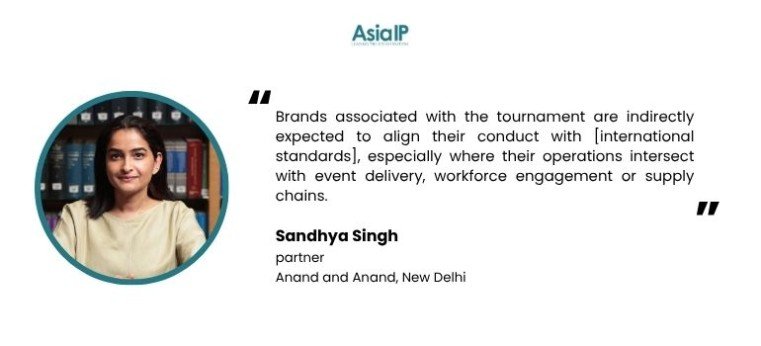
“This shifts sponsorship from a purely commercial engagement to one that carries compliance expectations. Brands associated with the tournament are indirectly expected to align their conduct with these standards, especially where their operations intersect with event delivery, workforce engagement or supply chains,” he said. “In practical terms, sponsorship agreements are likely to carry stronger contractual safeguards, including human rights compliance clauses and reputational protections. A brand’s conduct outside the tournament may also come under scrutiny if it conflicts with these principles. For Indian brands, this means that global sponsorship exposure now brings ESG-style obligations, where failure to meet expected standards can affect both contractual relationships and public perception.”
Brands, risks and challenges
Gooi said that it is important that when a brand links its IP to FIFA 2026 (whether through an official sponsorship or a co-branding campaign), it is drawing an association and that the brand is telling the public, implicitly, that it shares FIFA’s values and endorses the context in which its trademark appears.
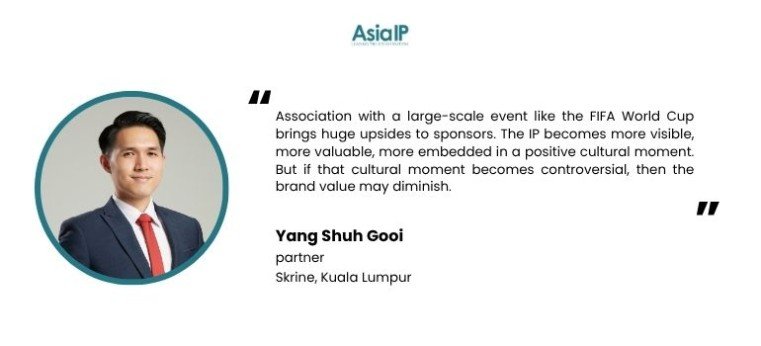
“That cuts both ways,” he said. “In ordinary circumstances, association with a large-scale event like the FIFA World Cup brings huge upsides to sponsors. The IP becomes more visible, more valuable, more embedded in a positive cultural moment. But if that cultural moment becomes controversial, then the brand value may diminish. With FIFA 2026, there are already live human rights and safety concerns around U.S. Immigration and Customs Enforcement raids being present on the ground at events as part of the security apparatus.”
“If a brand’s mark becomes associated, in the public mind, with a tournament that is seen to have failed on human rights, the damage could taint the entire brand. Brands spend considerable resources building and protecting their marks. It would be somewhat ironic if the association they paid a premium for turned out to be the thing that did the most damage,” he added.
He gave an example of how legal risks could happen. For example, some jurisdictions such as the EU have human rights due diligence legislation, obliging companies to identify and mitigate human rights risks across their supply chains. “Brands which associate themselves with an event like FIFA 2026 with its documented human rights criticisms, may risk exposing themselves to legal non-compliance,” he said.
He added: “In fact, the framework itself contains a section which explicitly commits to responsible contracting and transparent dealings. This includes procuring from contractors that demonstrate a commitment to human rights. Brands that want to have commercial dealings with FIFA 2026 will have to ensure their supply chains do not fall below those standards.”
Another potentially unanticipated risk, tied to the reputation risk, is contractual. “If human rights concerns arise during FIFA 2026, a brand may face real pressure to exit. However, if the sponsorship agreement does not have any clear exit clauses or specific termination rights for reputational harm, the brand may find itself contractually trapped between staying (and thus suffering more reputational harm) and leaving (and thus breaching the agreement and being exposed to legal liability),” said Gooi.
Singh said that as per the FIFA Intellectual Property Guidelines, FIFA exercises strict control over its intellectual property, and only authorized rights holders are permitted to use official marks, logos or identifiers for commercial purposes.
“Any unauthorized use or even conduct that creates the impression of an association can lead to legal action under trademark law, passing off and unfair competition principles. Activities such as branded promotions, commercial hashtags or domain names referring to the tournament can fall within this risk,” she said.
She continued: “Alongside IP risks, the FIFA World Cup 2026 Human Rights Framework highlights exposure arising from labour practices, supply chains and social impact. This creates a dual risk layer for brands. On one hand, there is legal liability for IP misuse. On the other, there is reputational and contractual exposure if the brand’s operations are inconsistent with the human rights expectations associated with the tournament.”
“Brands should also be mindful of ambush marketing risks, where non-sponsors attempt to create an indirect association with the tournament without official authorization. FIFA’s Intellectual Property Guidelines place significant emphasis on preventing unauthorized commercial associations, particularly where advertising campaigns, social media promotions, or event-linked branding create the impression that a company is officially associated with the tournament or is a FIFA rights holder. Even indirect references capable of implying such an association may attract scrutiny under trademark, passing off, unfair competition or related intellectual property principles,” she added.
Her colleague, Mudit Kaushik, a managing associate at the same firm, added that both legal and reputational risks are inherent in such an association. “As per the FIFA Intellectual Property Guidelines, any unauthorized use of FIFA’s intellectual property or creation of a misleading commercial association can attract enforcement action. This includes infringement proceedings, contractual consequences and restrictions on promotional activities,” he said.
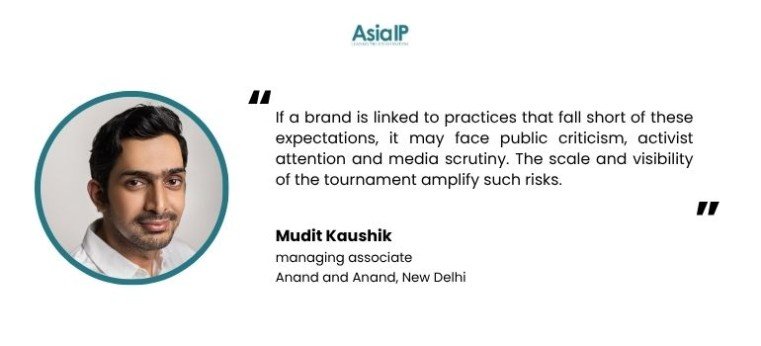
He added: “Separately, the FIFA World Cup 2026 Human Rights Framework places focus on issues such as worker rights, protection of vulnerable groups and non-discrimination. If a brand is linked to practices that fall short of these expectations, it may face public criticism, activist attention and media scrutiny. The scale and visibility of the tournament amplify such risks, meaning that even unrelated controversies can affect the brand’s association with FIFA.”
Managing brands at FIFA
According to Gooi, as a starting point, all brands should do a holistic risk-benefit analysis to assess whether they should enter into sponsorship deals with FIFA at all.
“For some brands, the reputational risks may outweigh the potential commercial benefits. In which case, the most commercially pragmatic decision might be to simply stay out in the first place,” he said.
He said that for brands that do decide to move forward with sponsorship deals, there are a few steps they can take to manage those risks.
“First, brands should contractually negotiate for exit clauses and termination rights tied to reputational harm or material human rights failures by FIFA or the host city committees. The second step is to conduct a supply chain due diligence to ensure the brand’s operations meet the procurement and transparency standards the framework contemplates. This is especially important for brands with exposure to European due diligence legislation,” he said.
“However, with FIFA 2026 already here, most major sponsors are likely already signed on. The contractual safeguards that should have been negotiated up front likely won’t be available anymore,” he noted. “That said, brands can still perform a gap analysis to identify whether their existing supply chain practices and enforcement practices align with the FIFA 2026 framework. If there are gaps, it is far better to address them proactively or at least be prepared to manage and communicate any shortcomings publicly if the need arises. Brands can also carefully think through whether their anti-counterfeiting enforcement strategy is consistent with the framework's commitments to vulnerable communities.”
Kaushik said that brands should approach FIFA sponsorship as a combined exercise in intellectual property compliance and responsible business conduct.
“As per the FIFA Intellectual Property Guidelines, any use of FIFA marks must be properly authorized, and brands must avoid even indirect or implied associations without rights. This requires careful structuring of marketing campaigns, promotions and digital presence to remain within permitted boundaries,” he said.
“At the same time, the FIFA World Cup 2026 Human Rights Framework requires alignment with standards on labour, inclusion and safety,” he added. “Brands should conduct due diligence on their supply chains, implement internal compliance mechanisms, and ensure that contracts include safeguards such as audit rights and exit provisions. The balance lies in leveraging the commercial visibility of the tournament while ensuring that business practices remain consistent with the ethical expectations attached to that association.”