

IP protection across countries joint hosting a major sports competition
29 May 2026
When major sporting events span multiple countries, protecting IP can become a complex cross-border challenge. Espie Angelica A. de Leon explores how FIFA and other tournaments coordinate enforcement across jurisdictions to protect their rights.
The 2026 FIFA (Fédération Internationale de Football Association) World Cup is set to kick off on June 11, 2026. For the first time, football’s premier competition will be jointly hosted by multiple cities in three countries – the United States, Canada and Mexico.
Co-hosting isn’t rare. Japan and South Korea hosted the 2002 World Cup, while Australia and New Zealand hosted the 2023 FIFA Women’s World Cup. That same year, the FIBA (Fédération Internationale de Basketball) World Cup was simultaneously held in Indonesia, Japan and the Philippines. The UEFA (Union of European Football Associations) Euro has also had its share of multiple hosts: Belgium and the Netherlands in 2000, Austria and Switzerland in 2008 and a record 11 countries in 2020. Meanwhile, India, Sri Lanka and Bangladesh hosted the Cricket World Cup in 2011. The list goes on.
As co-hosts of a major international sports tournament, countries not only share in the costs and infrastructure development, but they also share in the responsibility of making sure the IP rights of the sports governing body such as FIFA are duly protected across these multiple locations. So how can host countries align their efforts to manage and protect these IP assets?
Sports and IP: What are the assets and forms of infringement?
First, let’s take a look at these IP rights, particularly FIFA’s, and the possible scenarios that lead to infringement of IP rights.
FIFA’s IP portfolio, including those for the 2026 World Cup, includes the following: official emblem, wordmarks such as FIFA World Cup and FIFA World Cup 2026, slogans, logos, posters, mascot, trophy, the FIFA corporate mark, official typeface and more. All of these are protected under trademark and copyright laws. Only official FIFA partners and sponsors are authorized to use these IPs for their commercial activities.
Several registered patents also make up this portfolio. Among these are utility patents for the video assist referee, goal-line detection, semi-automated offside technology, camera stabilization, 3D ball tracking and others.
Ambush marketing is one of the more common activities where trademark rights may be infringed. A company or brand resorts to ambush marketing to associate itself with the sports competition such as the World Cup. To do this, the company uses the registered IPs related to the tournament in its advertisements, even if it is not an official sponsor of the sporting event.
Another form of ambush marketing is when a non-sponsor company greets an athlete it sponsors who is competing in the tournament – say, via social media – and shows its logo in connection with symbols or words associated with the event.
Unauthorized broadcasting is another common form of infringement. Broadcasting typically provides the biggest source of revenue. The FIFA World Cup, in particular, is one of the most viewed sporting spectacles globally. However, in this age of illegal streaming, live viewing events and illicit devices that allow free access to paid copyrighted content, a huge chunk of the money may be flowing into someone else’s pocket instead.
A third form of infringement is counterfeiting. FIFA licences its official memorabilia globally, from footballs, apparel, toys and pins to replicas of the World Cup trophy. These items carry with them FIFA’s official logos, word marks, emblems and other IP. The problem is that knock-off versions of these products often find their way into the market, no thanks to unscrupulous individuals who are not licensed to manufacture and sell these counterfeits.
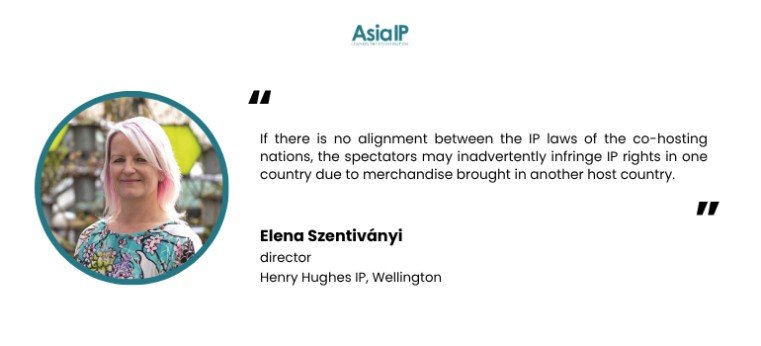
According to Elena Szentiványi, a director at Henry Hughes IP in Wellington, co-hosting nations are likely to have different types and levels of protection against ambush marketing, counterfeit goods crossing borders and brand dilution. “These differences may come to the fore when spectators are crossing borders between the co-hosting nations to attend games. If there is no alignment between the IP laws of the co-hosting nations, the spectators may inadvertently infringe IP rights in one country due to merchandise brought in another host country,” she said.

“A single FIFA tournament which will operate simultaneously under three distinct national IP regimes, three sets of customs enforcement authorities, three competition or unfair competition law frameworks and 16 city-level operational agreements requires an unprecedented legal and regulatory coordination,” stressed Raghav Malik, a partner at Lall & Sethi in New Delhi. “Honestly, the biggest thing is getting everyone on the same page early. You can’t have three separate IP strategies running in parallel and hope they somehow stay consistent. You need a common framework from day one.”So how should this common framework be put up?
Aligning of efforts for IP protection
A preparatory step is to conduct a thorough due diligence. “This involves compiling a harmonized inventory of all materials and matters that may need protection under the IP laws of the host countries. By preparing such a list or ‘inventory,’ organizers can ensure that every relevant item, whether it is already protected or requires protection, receives appropriate attention,” said Joan Janneth M. Estremadura, a senior associate at ACCRALAW in Manila.

Note that some of these materials, though they may already be protected under the relevant IP laws, might face specific restrictions when used for sporting events. Exclusive licenses granted to a single entity are one example. These may restrict the use of the IP only within specific territories. “Royalties or licence fees may be required before these protected materials may be used. Addressing these limitations early on ensures compliance and helps prevent potential legal issues,” said Estremadura.
To ensure aligned IP protection, the co-hosting nations or cities must consider a certain convergence of the threshold for registrability for IP rights. One example, though not directly related to sports competitions, is the regular “convergence meetings” held by the ASEAN member states through their respective IP offices. The aim of the meetings is to align certain practices on patent, design and trademark examinations, among others. This initiative has resulted in certain guidelines, such as the Common Guidelines for Patent, Design and Trademark Examination.
“The ASEAN Common Guidelines for Trademarks allow the protection for the names of unincorporated and non-profit organizations such as sports associations and provide them with exclusive rights that may justify an opposition to the registration of a mark that is identical or similar to the sports association’s name. A certain guideline may also be agreed upon by these host countries or cities in collaboration with their corresponding IP offices,” Estremadura stated.
Do the host countries or cities have certain exemptions for time-bound activities and events like sports competitions? Estremadura explained: “There are certain limitations imposed by the host countries’ laws or regulations that may affect the protection of IP rights, especially before, during and post-event. A common example is that each jurisdiction’s application process may vary, and the examination of these applications may affect the timely protection of the IP rights. A standard examination process may leave an IP right effectively unprotected in the early stages of the event, including during the critical promotional period.”
In the Philippines, Rule 601 of the Trademark Regulations of 2023 allows the priority examination of trademark applications for names, abbreviations of names and logos to be used in any sports competition held within a short period. “It would be advisable for host countries to adopt a similar approach by enacting similar regulations,” said Estremadura.
Further, she shared that their law firm had the opportunity to present its legal proposal for a sporting event in the Philippines. The proposal focused on both the legal system’s and the firm’s capacity to facilitate the immediate enforcement of IP rights. “This included ensuring that effective remedies were available, including robust takedown policies. Concerns include immediate enforcement actions on unauthorized dissemination of merchandise, especially in event-adjacent areas. It also raises concerns about temporary promotional installations or easily installed and removed stores, which pose challenges for enforcement,” Estremadura related.
Aside from this, sui generis temporary legislation must be enacted in each of the host countries for the duration of the tournament.
“An example can be found in New Zealand’s Major Events Management (MEMA) Act 2007 under which qualifying events taking place, at least in part, in New Zealand, can be declared a ‘major event’ and entitled to special protections for a specified period of time,” said Szentiványi.
Part 1 Preliminary Provisions of the Act state that its objectives are “to provide certain protections for events that are declared to be major events under this act in order to prevent unauthorised commercial exploitation at the expense of either a major event organiser or a major event sponsor,” among other purposes, “and for the protection, and control over the use, of certain emblems and words relating to Olympic Games and Commonwealth Games.”
FIFA, in particular, insists that cities bidding to host the World Cup must establish IP legislation governing its rights and those of its commercial partners throughout the competition. For its hosting of the 2022 World Cup, Qatar enacted Law No. 10 of 2021, which introduced the concept of Commercial Restriction Areas (CRAs). These refer to areas adjacent to the stadium where matches are being played and other event location with a radius not exceeding 2 kilometres. In these areas, commercial activities are not allowed on days when matches are taking place and the day before, unless authorized by FIFA.
Another key measure is to have a centralized brand protection programme led by the IP rights holder that the host countries or cities will have to comply with via host city agreements. “Every city commits to the same brand standards, the same clean zone rules, the same commercial partner protections. Of course, the enforcement mechanisms will be different in each country because the laws are different,” said Malik.
Lastly, there must be close coordination and collaboration between IP owners and relevant government authorities or more generally, between the government and the private sector. These may include the host countries’ IP office, customs office, enforcement authorities and local government units.
In connection with this, countries or cities co-hosting a sporting event may want to consider creating an inter-agency IP task force to enable uniform enforcement, efficient decision-making and quick action against counterfeiting.
Collaborating with ecommerce platforms, digital content providers and telecom regulators will also prove effective. “Currently, digital and online infringement, such as illegal streaming, misuse of event branding on social media or selling counterfeit merchandise, are common. Collaborating with key digital and communications stakeholders is essential to address these issues. These collaborations support stronger deterrent measures for rapid response to infringement, and such a proactive approach helps safeguard both the event’s brand and related IP in the rapidly evolving digital environment,” Estremadura pointed out.
Justisiari P. Kusumah, managing partner at K&K Advocates in Jakarta, agreed that being proactive when it comes to enforcement is key. His view is based on experience. The firm has assisted clients in enforcement actions involving broadcasting rights in connection with the FIFA World Cup. Infringers sold and used TV set-top boxes allowing access to the client’s subscription channels without authorization. The TV set-top boxes weren’t merely used by individual consumers. They were used by commercial establishments as well, such as restaurants and cafes. The device enabled them to organize live viewing events or watch parties for the matches and lure sports fans into their dining spots for the thrill of live sports action. At the end of the day, these establishments earned a profit, higher than their usual daily earnings, at the expense of the rightful FIFA World Cup licence holder.
“To address these infringements, we supported our client, as the rights holder, in facilitating coordinated enforcement actions, including targeted raids against third-party distributors of such devices. These actions were carried out in collaboration with law enforcement authorities, as well as relevant business and restaurant associations,” Kusumah related.
The firm also implemented a preventive outreach strategy to educate personnel at commercial spots such as restaurants, bars and cafes about hosting unauthorized viewing events and the legal implications of doing so. Carefully worded advisory letters were circulated, emphasizing that the licence holder reserved its rights to take legal action against any party infringing its exclusive broadcasting rights to the FIFA World Cup.
“Accordingly, education plays a critical role in any effective enforcement strategy. Right owners and right holders should consider collaborating with industry associations and law enforcement agencies to conduct targeted outreach programs. These initiatives can serve to inform restaurants, cafés and other commercial establishments of the legal framework surrounding broadcasting rights, as well as the requirement to obtain proper authorization before hosting viewing events. Such efforts not only promote compliance but also help prevent inadvertent infringement,” Kusumah pointed out.
Kusumah says the firm also assisted the client in recording its broadcasting rights with Indonesia’s Directorate General of Intellectual Property, which he says will strengthen evidentiary standing and support enforcement efforts against unauthorized use.
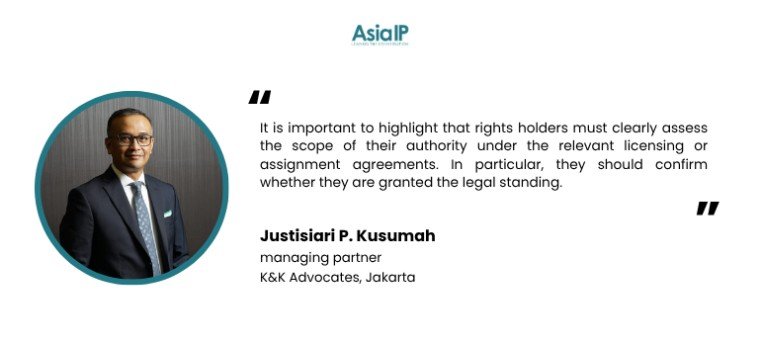
“It is important to highlight that rights holders must clearly assess the scope of their authority under the relevant licensing or assignment agreements. In particular, they should confirm whether they are granted the legal standing, including substitution or enforcement rights, to initiate further actions against third-party infringers,” he added.
The U.S., Canada and Mexico are gearing up for the World Cup. They aren’t just ready for the arrival of the football greats like Lionel Messi, Cristiano Ronaldo, Neymar, Luka Modric and the accompanying fan frenzy. They are also ready for the battle against IP infringement. FIFA has rolled out a robust enforcement strategy across all 16 host cities including strong measures for digital protection and against counterfeiting. Heavy patrolling of areas within a 2-kilometre radius from each stadium is part of these anti-counterfeiting efforts.
If everything goes well, July 19, 2026, will see not one, but four winners of the World Cup: the team that emerges as champion, plus the three host countries, for successfully hosting the tournament and protecting the IP rights of FIFA.