Trade secrets are emerging as powerful shields in industries where patents may fall short. Excel V. Dyquiangco unpacks their growing value, the rising risks of cyber and AI-driven theft, and how advanced cybersecurity, global cooperation and evolving legal frameworks are reshaping protection.
Trade secrets are valuable and adaptable solutions for protecting core assets and sustaining market competitiveness. While traditional IP such as patents is essential, trade secrets offer distinct advantages: they avoid the innovation-disclosure paradox by remaining confidential, protect a broader range of information – including client lists and internal processes – and have no time or geographical limits.
While this flexibility does not inherently make trade secrets superior to other forms of intellectual property, it does emphasize their growing importance, especially in a future dominated by artificial intelligence, proprietary algorithms and curated datasets. From the processes behind sustainable technology to the logic governing digital assets in the metaverse, trade secrets can be considered a dynamic tool for safeguarding the intangible innovations that define the future economy.
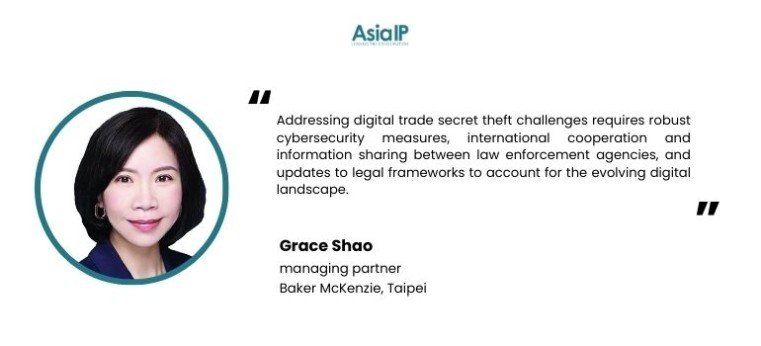
“In many ways, trade secret law can be broader or more flexible than traditional intellectual property like patents,” said Grace Shao, managing partner at Baker McKenzie in Taipei. “Unlike patents, trade secret protection can be obtained without any application or registration – it arises automatically if the trade secret owner takes appropriate steps to ensure the information is secret and so long as it provides a competitive benefit. Trade secret protection can also theoretically last if the information is kept a secret. Trade secret law also protects items which would not be proper subjects for consideration for patent protection. More importantly, trade secrets do not require public disclosure, making them particularly valuable for safeguarding competitive advantages in industries reliant on confidential processes, formulas and data.”
She noted that due to the novelty and complexity of AI innovations, traditional intellectual property protection, including copyrights and patents, has become ineffective. Under these circumstances, she said, trade secrets offer an effective substitute or alternative tool for safeguarding AI technologies.
“Trade secrets provide a way for safeguarding AI discoveries or inventions without any restrictions that are otherwise imposed by copyrights and patents,” she said. “Whether patents can be effectively enforced against infringers in a time-efficient manner is also crucial for business. The reality – since the U.S. Supreme Court’s decision in eBay – is that patent owners simply cannot expect to obtain injunctive relief anymore. Patent validity can also risk being challenged in an infringement case. Therefore, I see the trend that patents in the United States, Taiwan and many jurisdictions are becoming weaker and simply not desirable for certain innovators or businesses.”
“So, it is easy to understand why so many innovators and innovative companies are increasingly exploring trade secrets as an alternative – particularly where you know that you can’t obtain a patent, or the patent you might obtain just is not worth the effort and expense,” she added.
In Taiwan, protection of trade secrets has strategic importance, and the laws have been amended to grant stronger protection. Taiwan Semiconductor Manufacturing Company (TSMC) adopted a trade secrets recordation system to record valuable trade secrets innovations as critical assets, in addition to patents and other IP rights.
Chris Jordan, managing principal at Davies Collison Cave in Melbourne, has a different view. He is not sure it is the case that trade secrets have evolved to become a more critical asset than traditional forms of IP, such as patents.




-content_x-large.jpg)
-content_x-large.jpg)